How long you will wait for a Ragdoll kitten
Consistently available, and consistently subject to a colour-and-pattern queue. Seal and blue in mitted or bicolour are the volume combinations and move fastest; lynx and tortie patterns, chocolate and lilac, and a specific blaze or glove marking are all reasons a cattery will tell you to wait for a planned litter.
Ragdolls breed reliably and the breed is popular enough here to support both local queens and steady import, so supply is better than for the large semi-longhairs. What thins it is that the exact pattern people want is decided by genetics rather than by the cattery, so any given litter yields only a few kittens matching any given request.
The biggest time-saver: Decide whether you care about pattern or about temperament, and if it is temperament, drop the pattern requirement. A mitted seal from this litter behaves exactly like the bicolour blue you are waiting three litters for.
Nothing above is an offer: we hold no Ragdoll kittens and publish no stock list. For the same picture across every breed, see what sets the wait for each breed.
What a Ragdoll kitten is actually like
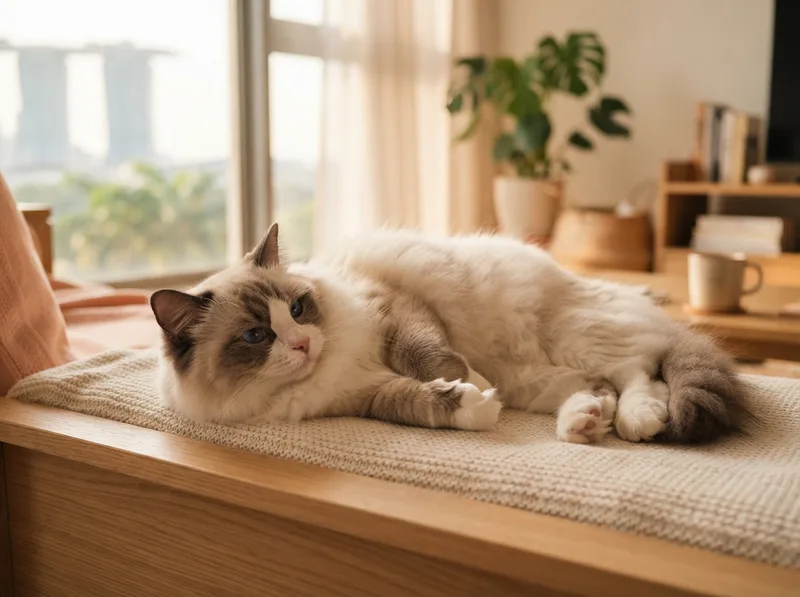
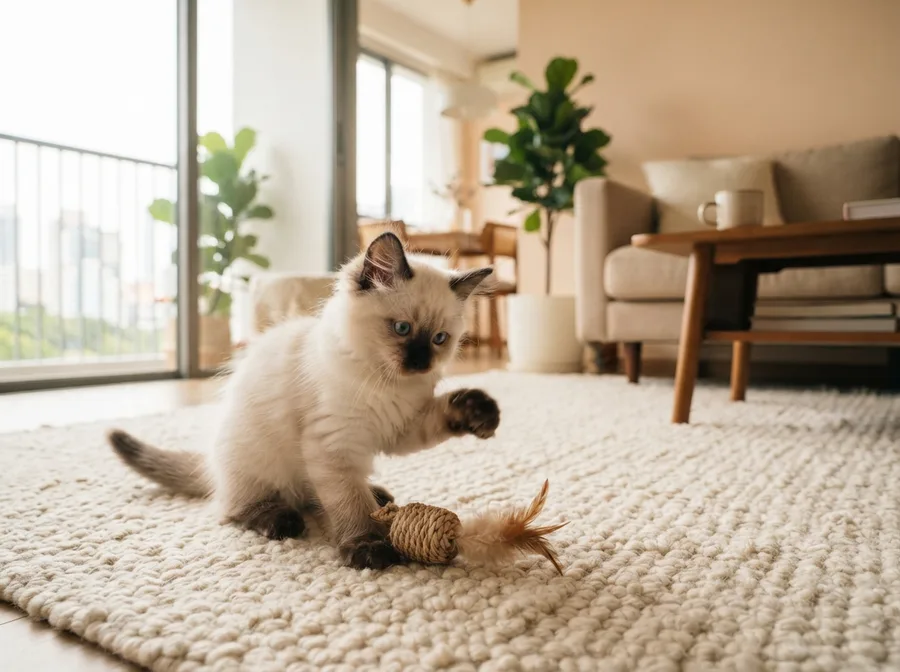
Ragdoll kittens are born white. The colourpoint develops over the following weeks and keeps developing long afterwards, which means the kitten you view at eight weeks is a poor guide to the adult cat — points darken, patterns sharpen, and a cat can look substantially different at two years old. Buyers who choose on the photograph are frequently surprised later, in both directions. Coat length also builds gradually, so the full ruff belongs to an adult. Like the Maine Coon, the Ragdoll is a slow finisher: full size arrives around the third or fourth year, and a kitten leaving at twelve weeks is still a long way from the cat it will become.
Those three are Ragdoll-specific. For the checks that apply to any cattery, see verifying a seller properly.
Checklist
- A “Ragdoll” kitten with fully developed adult points at eight weeks. The pattern develops over months; a strongly marked young kitten is usually a different colourpoint breed or a mix.
- No PKD or HCM testing named for either parent. “Vet checked” is not a genetic test and is not a scan.
- A guarantee of adult eye colour or of a specific blaze. Both are genetic lotteries, and promising them is a sales technique.
Grooming and daily life with a Ragdoll in Singapore
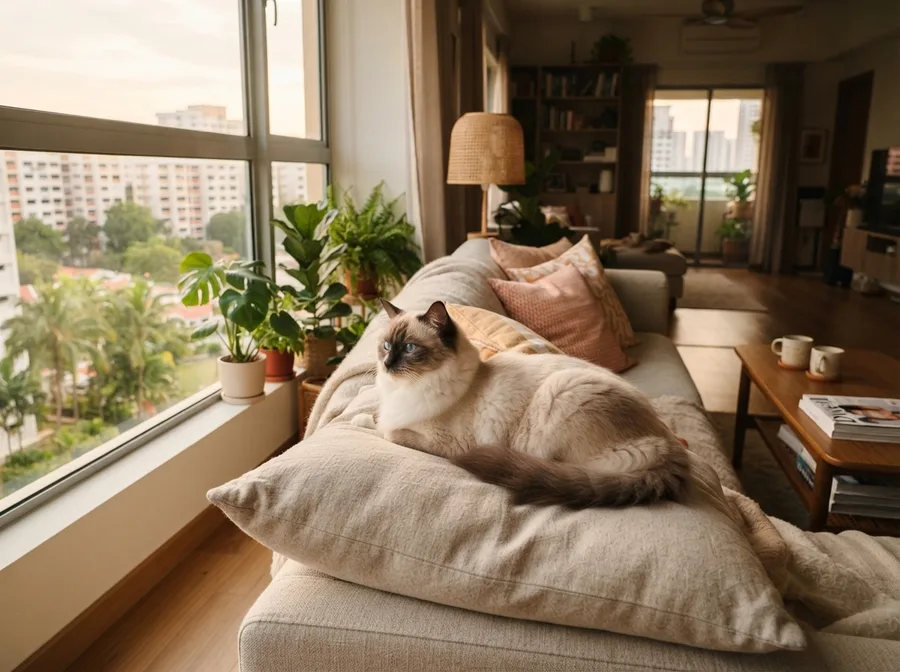
Two or three combings a week. The Ragdoll coat is semi-long and silky with comparatively little undercoat, which is why it mats less readily than a Maine Coon’s or a Persian’s — but “less readily” is not “not at all”, and the britches and the area behind the ears still need checking. The practical Singapore note is that a Ragdoll living permanently in air conditioning holds more coat than one that does not, so the routine tends to be steadier and slightly heavier here than the breed’s reputation implies. Nails need regular attention too, because this is a cat that will be handled a great deal, and a relaxed cat with long claws still leaves marks.
The Ragdoll is the most people-oriented cat in this set, and that cuts both ways. It will follow you between rooms, sit where you sit and go limp when picked up, which is exactly what most buyers want. It also means a Ragdoll left alone from morning to night every day is a cat whose main need is not being met — this is the breed where taking two rather than one genuinely changes the outcome, and an HDB flat may hold two. They are quiet and soft-voiced, undemanding about vertical space, and generally poor at self-preservation: a trusting cat that does not startle away from an open window is precisely the cat that needs the mesh.
What a Ragdoll costs to keep
Middling on food, higher than average on grooming tools and time, and worth planning for on two health lines. Hypertrophic cardiomyopathy is documented in the breed and polycystic kidney disease appears in some lines, so genetic testing of the parents matters at purchase and periodic monitoring is a reasonable ongoing cost. Beyond that the expenses are the ordinary ones — quality food, litter, annual boosters — plus, for this breed specifically, accepting that whatever furniture sits nearest the window will collect silky pale hair for the next fifteen years.
For Ragdoll figures set against other breeds, with every source named and dated, see what published figures actually say; for the month-by-month picture, the budget after the kitten.
Also worth reading: the Maine Coon
Maine Coon buyers and Ragdoll buyers are often deciding between two large affectionate semi-longhairs. The split is grooming load and space: a Ragdoll asks less of both, and a Maine Coon gives you more cat. Neither is the better animal — the flat and the brush decide.