The rule, stated plainly
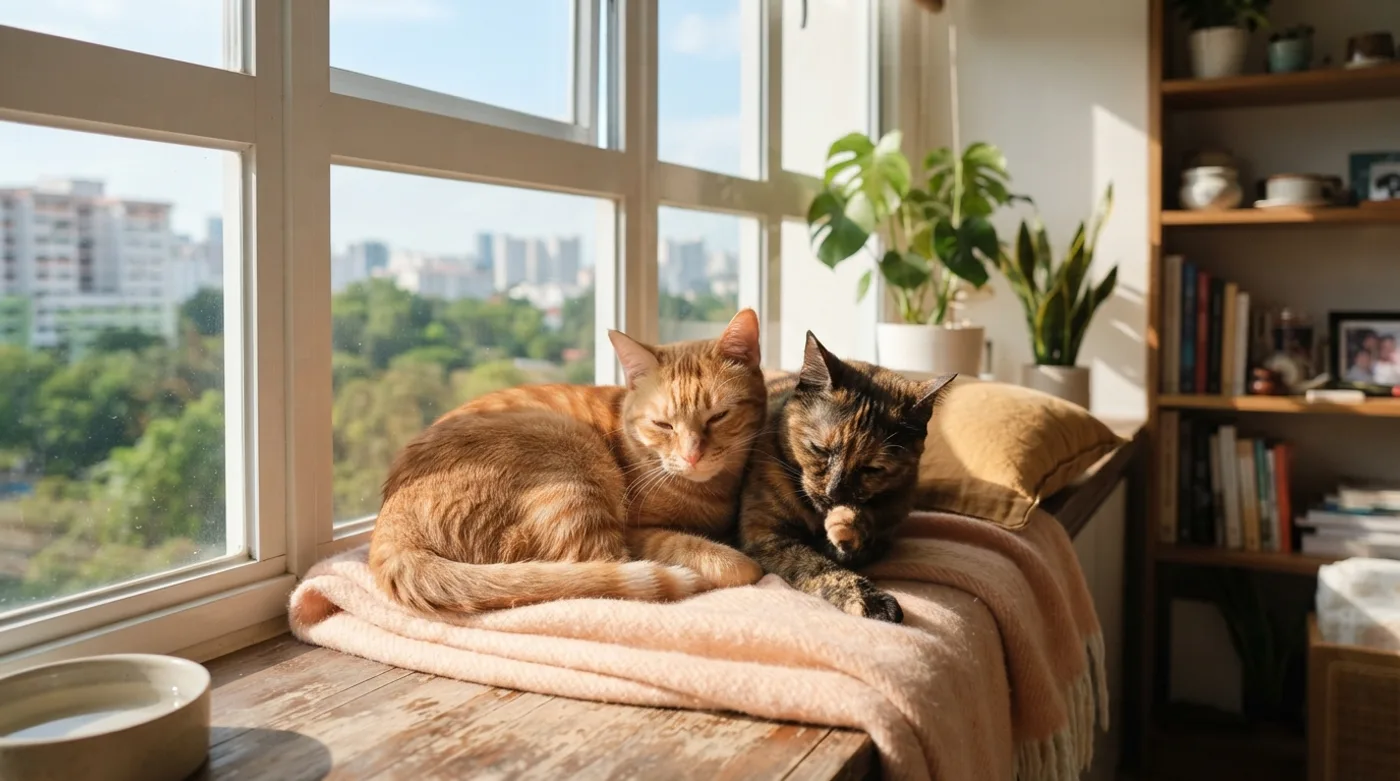
Under the Cat Management Framework, an HDB flat may keep up to two cats. Private residential property is permitted more. That is the entire rule, and it applies regardless of flat size — a two-cat cap in a five-room flat and a two-cat cap in a three-room flat are the same cap.
The cap is about residential density rather than about cats being difficult. Flats share walls, corridors, ventilation and refuse chutes, and the framework is built to make cat ownership sustainable in that environment rather than to make it hard.
The cap is only one of the conditions attached to keeping a cat in a flat. The rest — microchipping, licensing, keeping the cat indoors, meshing windows — are set out in a plain-English walkthrough of every HDB cat rule.
Because the cap and its conditions can be updated, confirm the current number before you commit to a second or third animal. The framework is new, and the sensible habit is to check the source rather than a forum thread.
There is one exception, and it expires. AVS grandfathers households that were already over the cap: cats owned before 1 September 2024 may be kept beyond the limit provided they are licensed during the transition period, which ends on 31 August 2026. Cats acquired after 1 September 2024 are not covered. Miss that window and the standard cap applies from then on, whatever the household looked like before. If you are over the cap and have not licensed every cat, this is the single most time-critical thing on this page.
If you are already over
Households that already kept more than two cats before the framework existed are common, and AVS provides for them — but only through licensing, and only until 31 August 2026. License every cat you already have, then speak to AVS directly. Either is a far better position than waiting to be reported by a neighbour.
Is one cat or two better in a flat?
The instinctive answer is that a small flat means one cat. In practice, for most working households in Singapore, two is the easier number — and the reason is time rather than space.
A single indoor cat left alone from eight until seven has nothing to do for eleven hours. That boredom does not stay contained: it becomes 5am wake-up calls, over-attachment, scratched furniture and the sort of attention-seeking that owners interpret as a personality problem. Two cats sleep, wrestle, groom and chase each other through the same eleven hours and greet you as a bonus rather than as the only event of their day.
The genuine costs of the second cat are financial and logistical, not spatial. Double the vaccinations, double the sterilisation, double the food and litter, and a second licence when the free period ends. If that arithmetic works, two is usually the kinder choice in a flat.
Setting a flat up for two cats
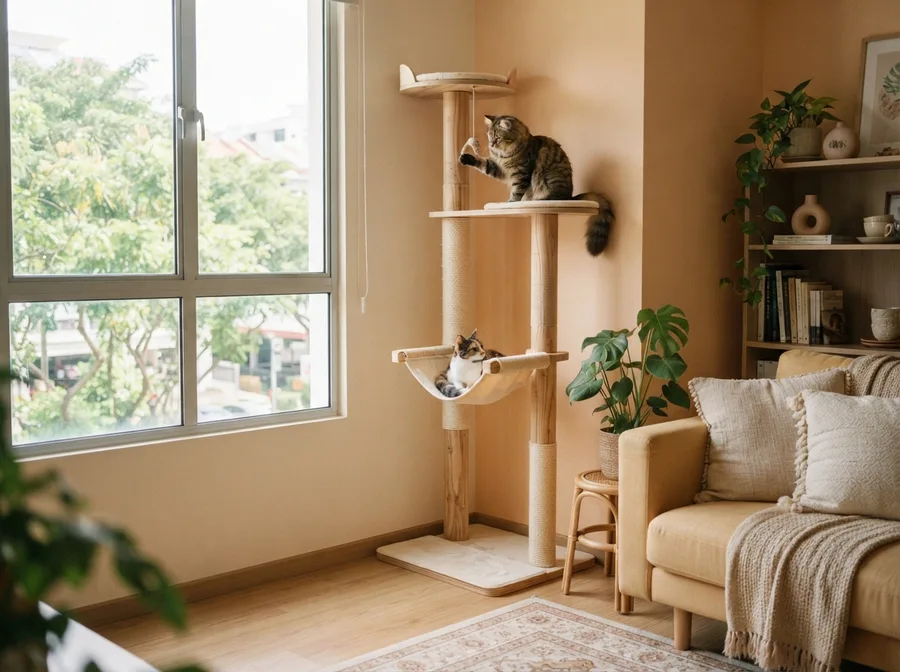
Two cats in a flat is a resource-planning exercise. Get these right and the pair essentially runs itself.
Almost every "my two cats fight" problem in a flat traces back to competition for a resource that exists in only one place. Duplicate the resources and the conflict usually disappears without any behavioural intervention at all.
Checklist
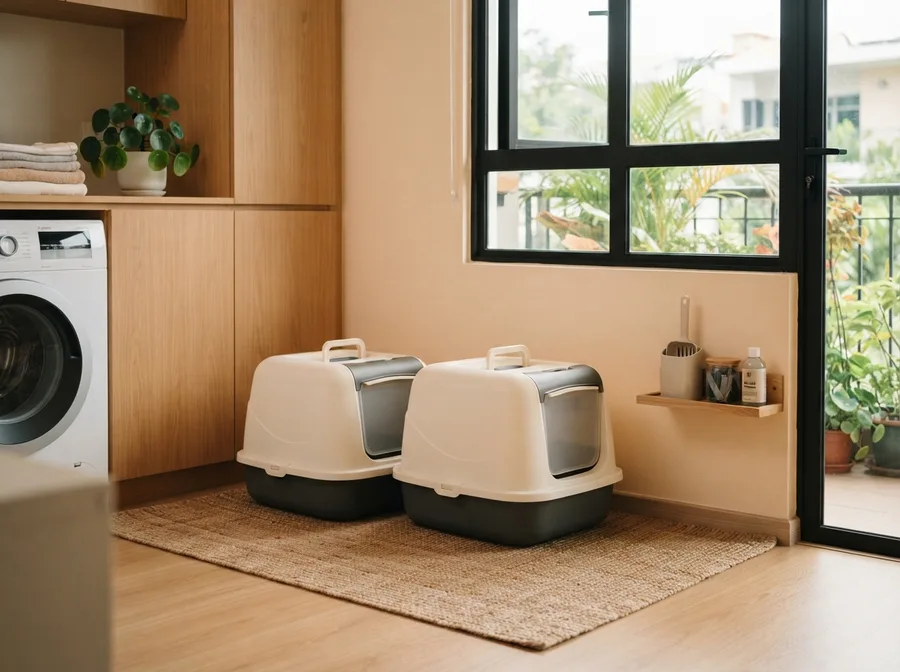
- Two litter trays minimum, in different rooms — never side by side, which counts as one
- Separate feeding stations, far enough apart that neither cat can guard both
- Vertical space — a cat tree or shelf run so they can occupy different heights
- Two hiding spots, so a cat that wants out of a situation has somewhere to go
- Two water sources, ideally away from the food
- Mesh on every window — two cats, twice the curiosity, same fall risk
Introducing a second cat properly
Rushing this is the single most common cause of a permanently tense household. It takes days to weeks, not minutes.
- 1Separate room firstThe new cat lives in one room with its own tray, food, water and hiding spot. No visual contact for the first days.
- 2Swap scentsExchange bedding between the two, and let each explore the other's space while the other is elsewhere. Scent does most of the work.
- 3Feed on either side of a closed doorBoth cats associate the other's smell with something good. Move the bowls closer over several days.
- 4Brief supervised visual contactA gap in the door or a barrier, for minutes at a time, ended before anyone gets tense rather than after.
- 5Short shared sessionsSupervised, in a neutral room, with an easy exit for both. Extend gradually.
- 6Full accessOnly once shared sessions are consistently boring. Boring is the goal.
Two kittens introduced young skip most of this. An adult resident cat meeting a new kitten needs the full process, and going slowly at the start saves months of tension later.
Which breeds share a flat well
Some breeds are markedly easier as a pair in a confined space than others.
Every one of our breed guides gives a straight HDB verdict, and the best breeds for HDB flats guide ranks them specifically for flat life.
Easy in pairs
British Shorthairs, Ragdolls and British Longhairs are tolerant, low-conflict cats that generally accept a companion without drama.
Needs more management
High-energy breeds such as the Bengal can pair well — with each other, in a home with real climbing height. Two Bengals in a bare flat is a lot of cat.
Watch the vocal ones
Two Siamese is double the conversation. Wonderful if you want that; a genuine consideration if your walls are thin.
Licensing two cats
Each cat needs its own microchip and its own licence. There is no household licence and no discount for the second animal — two cats means two applications through PALS, and eventually two fees once the free period ends.
Doing both at the same time is the practical move: same session, same evening, both diarised for renewal on the same date. Licensing is free until 31 August 2026, so a household with two unlicensed cats currently has two free applications sitting on the table.
The full process is in our licence your cat, and the wider framework in what the Cat Management Framework requires.
The cat ownership limit, in detail
The cap is the part of the framework people ask about most, and the details around it are where the honest answers thin out.
Two cats per HDB flat, and three cats and/or dogs in private premises. Both figures are AVS’s, verified from its Cat Management Framework pages on 27 July 2026, and note what the private figure actually says: it is a combined cap on cats and dogs together, not three cats on top of a dog.
The framework began on 1 September 2024 with a two-year transition period running to 31 August 2026. Licensing is free through that window, and from 1 September 2026 it becomes an offence to keep an unlicensed pet cat. A cat must be licensed as a pet cat under the scheme, and AVS’s fee table sets a separate reduced rate for animals below five months of age — in practice, license the kitten as soon as you have its microchip number rather than waiting for it to reach three months of age.
Two areas where we will not give you a number, because AVS has not published one we can quote. First, grandfathering: households that already kept more cats than the cap when the framework started are the obvious question, and the published pages describe the transition period without setting out a per-household exemption we can restate. Second, fosterers — AVS does say fosterers should license the cats they foster and can transfer a licence to the adopter through PALS, which tells you fostering is inside the licensing system, but not how the cap applies to a foster household. If either applies to you, ask AVS directly and get the answer in writing rather than relying on a summary, including ours.
There is no approved breed list for cats. The dog schedules do not have a cat equivalent under this framework, so the constraint is the number, the licence and the microchip — not the breed.
Checklist
- HDB flat: two cats
- Private premises: three cats and/or dogs combined
- Framework start: 1 September 2024 · transition ends 31 August 2026
- Unlicensed pet cat becomes an offence from 1 September 2026 — the penalty schedule is AVS’s to state, so confirm it there
- Microchip first, then licence — the licence is tied to the chip number
- Renting? The framework does not override your tenancy agreement