Kitten.sgFind my kitten

Singapore breed guide

Bengal Cats in Singapore

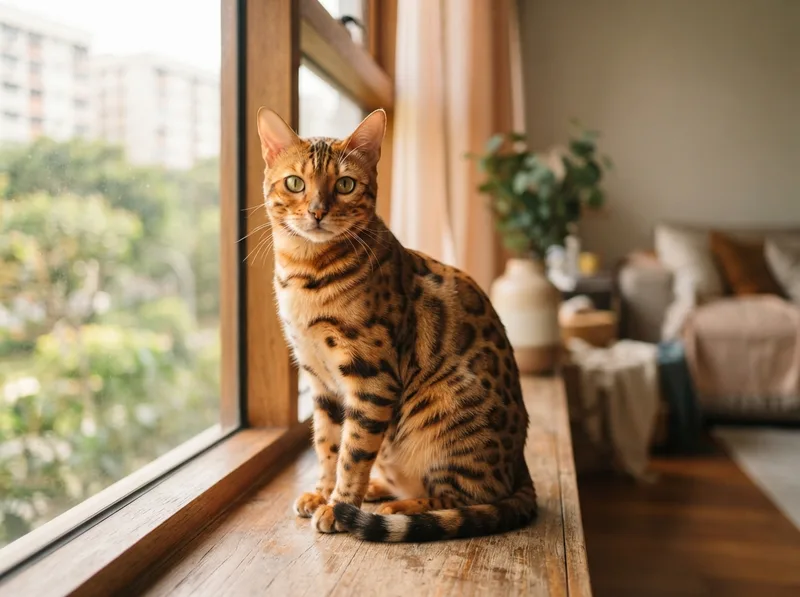
Bengals look like miniature leopards and behave like feline athletes. They are rewarding for active owners but are one of the more demanding breeds to keep satisfied indoors.

Medium–largesizeShort, spottedcoatMinimalgroomingNeeds enrichmentHDB fitActive, clevertemperament12–16 yearslifespan

Is the Bengal a good cat for Singapore, and what does one cost?

The Bengal is an athletic, wild-looking cat with a spotted or marbled coat and very high energy. It is intelligent and playful but needs serious enrichment, which is challenging in a small flat. Some early hybrid generations may be import-restricted in Singapore. Indicative local prices typically run from around S$2,500 to S$6,000.

By the Kitten.sg editorial teamResearched in SingaporeUpdated 25 July 2026

At a glance

Indicative price
Indicative S$2,500–S$6,000 (generation and markings affect price; verify import rules)
Good for
Active owners who can provide vertical space, play and enrichment every day.
Think twice if
You want a calm lap cat or have limited time and space — Bengals need a lot.

Indicative Bengal ranges observed in the Singapore market — what a specific kitten costs depends on its litter, its colour and its lineage. We sell nothing and set no prices.

What the Bengal is really like

Bengals are highly energetic, intelligent and curious. They climb, leap, play fetch and often love water. Without enough stimulation they can become destructive.

The short, luxurious coat needs almost no grooming and shows off the breed’s signature rosettes and glittered look.

Bengals are descended from the Asian leopard cat, and early-generation hybrids (F1–F4) may face ownership or import restrictions. Later-generation domestic Bengals are the typical pets — always verify legality and paperwork.

Comparing options? Many Singapore buyers also look at the Sphynx. If you have not settled on buying at all yet, start with start with the overview.

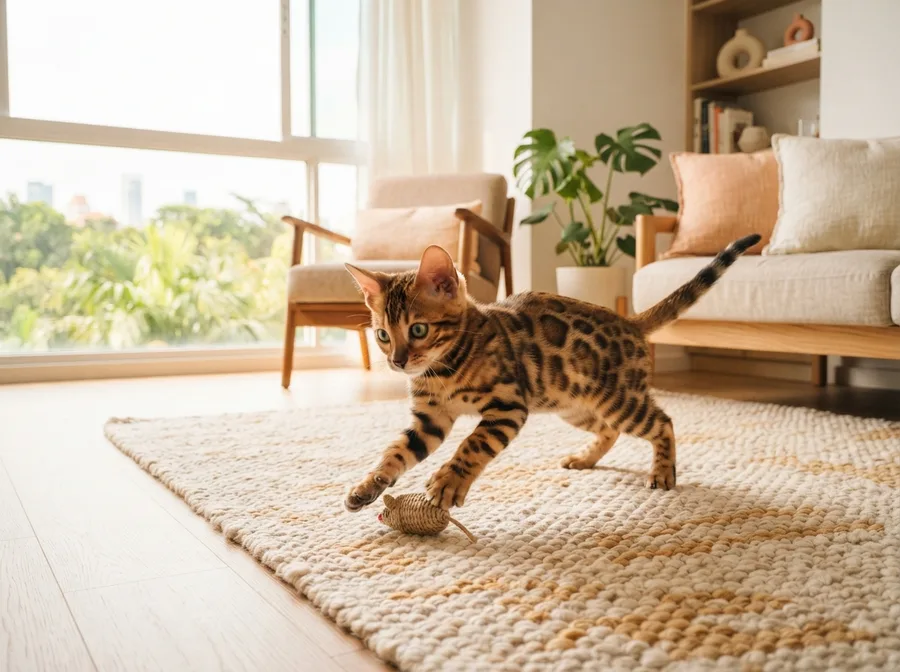
A Bengal kitten playing on a rug

Honest pricing

Bengal price in Singapore

Indicative S$2,500–S$6,000 (generation and markings affect price; verify import rules).

Bengal pricing is coat-first. Rosetting quality — the size, contrast and outlining of the rosettes — is what separates a mid-band kitten from a top one, along with glitter and background clarity. Silver, charcoal and snow variants sit above brown, and the rarer combinations above those. Generation matters legally as well as commercially: early-generation hybrids are treated differently on import and are not a pet-market proposition here. Most Singapore Bengals are well removed from that ancestry.

Every figure we could attribute to a named, dated source sits on what published figures actually say.

Buying a Bengal: the check that matters most

Before you price a Bengal, price the environment it needs. This is a cat that will find a job whether or not you give it one, and in a bare flat the job is your furniture at four in the morning. Budget for vertical space, a wall shelf run and structured daily play before you budget for the kitten. Ask about PRA and PK-deficiency testing, and about HCM, and check the import status of the line with AVS if it is described as early-generation.

Living with a Bengal in an HDB flat

Possible in an HDB flat only with heavy enrichment — tall cat trees, puzzle feeders, daily active play. Under-stimulated Bengals struggle in small spaces.

Framework rules — two cats per flat, microchip then licence — are set out in HDB cat ownership, explained.

Bengal health to watch for

  • Hypertrophic cardiomyopathy (HCM) and progressive retinal atrophy (PRA-b) — ask for testing.
  • Patellar luxation in some lines.
  • Verify generation and import legality with AVS before buying.

Ask for screening results on both parents by name, not a verbal assurance — verifying a seller properly lists the wording to use.

How long you will wait for a Bengal kitten

Wanted more often than it is offered here, and the wait is real. Bengal litters are announced rather than held, and the rosetted brown cats most buyers picture are only part of a litter — asking for a particular pattern quality, a snow variant or a specific generation narrows an already narrow supply.

Few catteries in the region breed Bengals at scale, and the breed carries a regulatory dimension others do not: because the Bengal descends from a wild species, generational distance from that ancestor matters for import and ownership rules. Anything you are offered should be a well-established later generation, and that is a question to settle before money is discussed.

The biggest time-saver: Stay open on pattern and colour, and prioritise a cattery that will talk clearly about generation and about HCM and PK-Deficiency screening. Chasing one specific rosette pattern is what turns a search into a year.

Nothing above is an offer: we hold no Bengal kittens and publish no stock list. For the same picture across every breed, see what is realistically findable here.
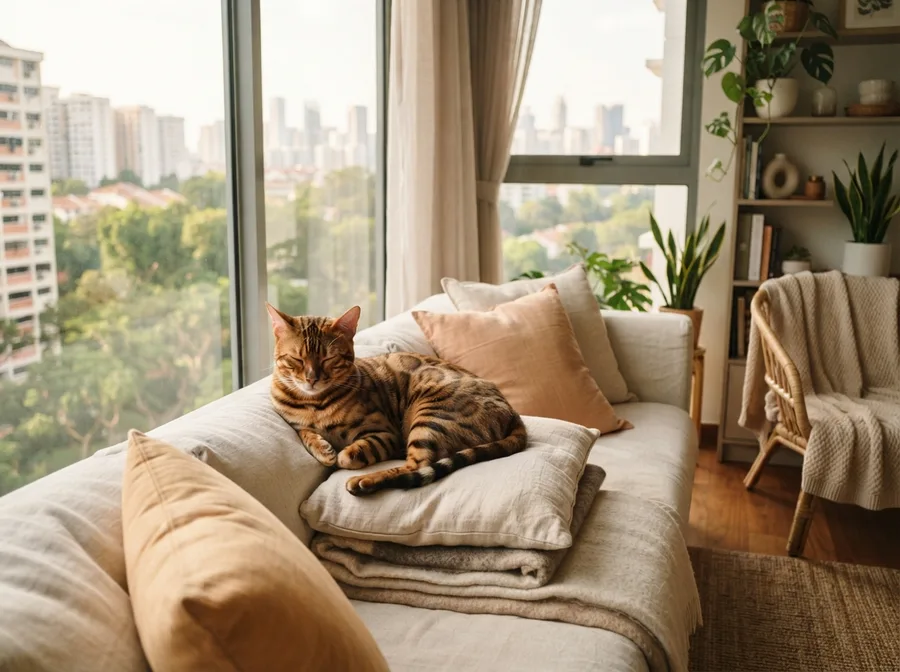
An adult Bengal resting on a sofa by a window

What a Bengal kitten is actually like

Bengal kittens go through a well-known and often unannounced phase called fuzzies: the pattern that was crisp at a few weeks old greys out and softens, then sharpens again as the adult coat comes in. A kitten in fuzzies looks muddy, and a buyer who does not know this assumes the cat has lost its markings. It has not. What it does mean is that you cannot assess final pattern from a young kitten, so look at both parents instead. The other thing to expect is the energy, which is present from the first day and does not moderate much: a Bengal kitten is faster, more physical and considerably more inventive than any other kitten on this site.

Those three are Bengal-specific. For the checks that apply to any cattery, see what to ask before you visit.

Checklist

  • Vagueness about generation. Descent from a wild ancestor makes generational distance a legal and welfare question here, not a marketing detail, and a seller who will not state it plainly has answered you.
  • A spotted domestic shorthair sold as a Bengal. Spots are not a pedigree; papers and parents are.
  • No named screening for HCM, PRA-b or PK-Deficiency — all three have tests, and “healthy parents” is not one of them.

Grooming and daily life with a Bengal in Singapore

The lightest routine here. The coat is short, close-lying and unusually fine — many Bengals carry a glitter to it — and it sheds little. A weekly wipe or rubber-mitt pass is ample, and many owners do less. What replaces grooming as the daily commitment is exercise, which is not a trade most first-time buyers appreciate until the cat arrives. Nails need regular trimming because they get used hard on furniture. And a Bengal is one of the few cats here that genuinely enjoys water, which makes the rare necessary bath easy and makes an unattended full sink a shared activity.

The hardest cat on this list to keep well in an HDB flat, and it is nothing to do with the cat being difficult. Bengals are athletic, extremely intelligent and busy, and an under-exercised Bengal does not sulk — it redirects, into your cabinets, your taps, your curtains and your night. Keeping one properly in a flat means building upward: tall climbing furniture, shelf runs, wheel or fetch play, puzzle feeders, and real interactive sessions daily rather than a toy left on the floor. Do that and the breed is superb in a flat. Skip it and you have a behaviour problem you will blame on the breed. They are also loud when they want something, which shared corridors amplify.

An adult Bengal resting on a sofa by a window

What a Bengal costs to keep

Low on grooming, high on everything designed to keep the cat busy — climbing furniture, replacement toys, puzzle feeders — and that is a genuine recurring line rather than a one-off, because a Bengal destroys and outgrows enrichment. Health-wise, plan around three documented lines: hypertrophic cardiomyopathy, progressive retinal atrophy and pyruvate kinase deficiency, all of which have parental testing available and all of which are worth confirming at purchase. Feeding costs sit above average for the cat’s size because of activity level. And budget realistically for the furniture and the flyscreens.

For Bengal figures set against other breeds, with every source named and dated, see what a kitten costs here, with sources; for the month-by-month picture, the running costs, laid out.

Also worth reading: the Sphynx

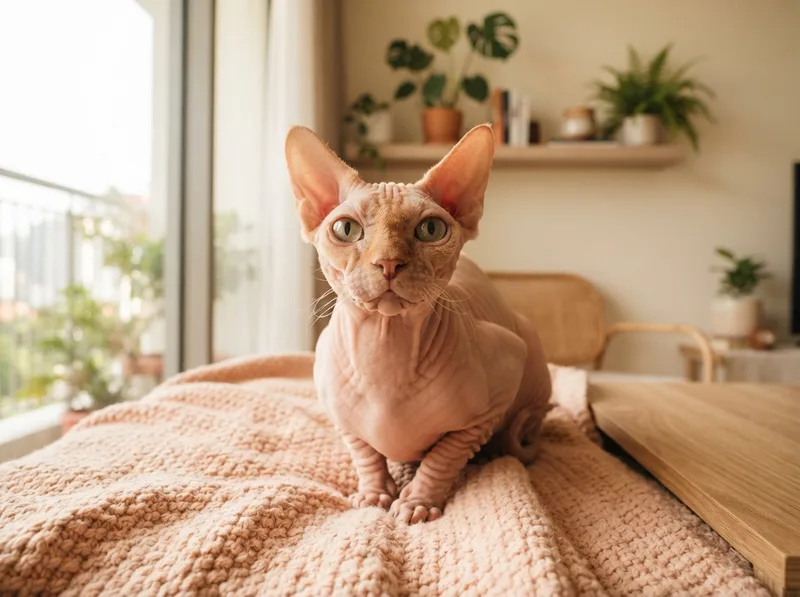
The Sphynx is the honest comparison for a buyer drawn to a cat with real presence and real demands. Both need a household that engages daily; the difference is where the work lands — enrichment and space for a Bengal, skin and bathing for a Sphynx. Buyers who want the look without the workload should be reading the British Shorthair page instead.
Other breeds Singapore buyers compare

Your kitten search

Looking for a Bengal kitten?

Tell us the colour, gender and timing you'd like and we'll search Singapore's licensed breeders and catteries for a Bengal that matches — then arrange a viewing.

Free, and there is no obligation to buy anything. We use your details only to search for your kitten and to reply to you.

Bengal FAQs

How much is a Bengal cat in Singapore?

Indicative local prices typically run S$2,500–S$6,000, varying with generation and markings. Confirm the kitten is a later-generation domestic Bengal and check import paperwork.

Are Bengal cats legal in Singapore?

Later-generation domestic Bengals are commonly kept, but early hybrid generations can face restrictions. Always verify the specific cat’s generation and import status with AVS before buying.

Are Bengals good for HDB flats?

Only with serious enrichment. They are extremely active and can become destructive if bored, so plan for climbing space and daily play.

Your kitten search

Ready to meet a Bengal?

Tell us what you want in a Bengal — colour, gender, when you'd like it home — and we'll go and find it.

Tell us what you want

Compare first?

See how the Bengal stacks up against every other breed available in Singapore.

all sixteen breed guides
what is realistically findable here
Tell us the kitten you want