The licence-fee arithmetic
Sterilisation is the one health decision with a directly quantified financial consequence in Singapore.
The S$35 one-time option for a sterilised cat is the striking number: it is less than six months of the unsterilised annual fee, permanently. Fees can be revised, so confirm the current schedule at AVS before planning around them — but the structure has been stable since the framework was announced.
Key numbers
- Licence now (to 31 Aug 2026)
- Free, either way
- Sterilised, from 1 Sep 2026
- S$15 per year
- Sterilised, one-time option
- S$35
- Unsterilised, from 1 Sep 2026
- S$90 per year
- Difference per year
- S$75
- Over a 15-year life
- Substantial
What sterilisation actually changes
The fee is the smallest reason. The behavioural case is the one that matters in a flat.
Calling. An unsterilised female in season vocalises — loudly, repeatedly, for days, and then again a few weeks later. In a landed house that is an irritation. In an HDB flat with shared walls it is a neighbour complaint waiting to happen, and it is not something that can be trained away.
Spraying. Unsterilised males mark territory with urine that is specifically designed to be pungent and persistent. Once the habit is established it can outlast the procedure, which is the practical argument for sterilising before the behaviour starts rather than after.
Escape pressure. An intact cat has a strong drive to get out and find a mate. In a high-rise flat that drive meets a window, and that is the scenario every Singapore vet has seen too many times.
On the health side, sterilisation removes the risk of certain reproductive conditions entirely and reduces others. The specifics are a conversation for your vet, who knows your cat.
Timing beats reversing
Spraying is much easier to prevent than to stop. If the plan is to sterilise, doing it before the behaviour establishes is materially better than doing it after — ask your vet for the right age for your kitten.
The procedure and recovery
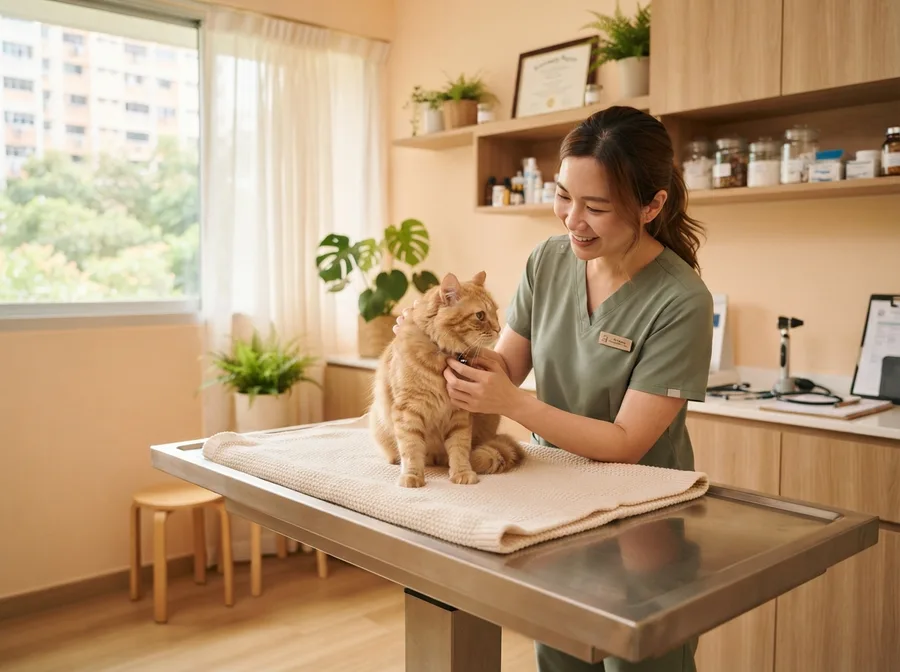
Routine, day-case surgery in almost every case. The recovery is short and the failure mode is predictable.
- 1Pre-op checkYour vet examines the cat and confirms it is a suitable age and weight. Fasting instructions come from the clinic — follow them exactly.
- 2The procedureUnder general anaesthetic. A male neuter is shorter and simpler; a female spay is abdominal surgery and correspondingly a longer recovery.
- 3Same-day homeMost cats go home the same day, groggy and unimpressed. Keep them in a quiet, warm room with easy access to a low-sided litter tray.
- 4The collarThe recovery collar is the whole game. Cats that reach their incision cause the only common complication, and they will try.
- 5Days 1–3Appetite and energy usually return quickly. Check the incision daily for redness, swelling or discharge.
- 6Activity restrictionNo jumping or rough play for the period the clinic specifies — longer for a female. This is the instruction most owners quietly shorten, and it is the one that matters.
Ring the clinic rather than the internet if the incision looks wrong, if the cat is not eating by day two, or if it is persistently lethargic. All three are cheap phone calls and expensive things to ignore.
The honest trade-offs
Not a decision without any downsides. These are the real ones, and they are all manageable.
Sterilisation is close to a default recommendation in Singapore, and it should still be a decision you make knowingly rather than one you drift into.
Checklist
- Anaesthetic risk — small in a healthy young cat, but never zero. Your vet will assess it.
- Weight gain — metabolic needs drop, so portions must drop with them, or the cat will gain
- Irreversibility — if you have a genuine intention to breed under a licence, this is the decision to think through
- Recovery management — a collar, restricted activity and a fortnight of supervision
- Up-front cost — a real one-off expense, partly offset by the lower licence fee over time
Community cats are a different question
Sterilisation of community cats runs through trap-neuter-return-manage programmes rather than through individual pet ownership, and subsidised options exist specifically for that work. If you feed community cats and want to help with sterilisation, the established welfare groups are the route, not a private clinic booking.
If you are taking a community cat into your home as a pet, it becomes a pet cat in the eyes of the framework: microchip, licence, and sterilisation on the same footing as any other. Our licence your cat covers what changes.
Spaying, neutering and what each procedure involves
Sterilisation is one word for two different operations, and knowing which one your cat is having makes the vet conversation shorter.
Spaying is the procedure for a female cat: an ovariohysterectomy, which removes the ovaries and uterus through a small abdominal incision. It is the more complex of the two because it enters the abdomen, so recovery involves a little more restriction — no jumping, no bathing, and a cone or recovery suit until the incision is closed. Neutering a male cat is simpler and quicker, with no abdominal entry and a faster return to normal.
Both are elective procedures, which means you choose the timing rather than reacting to a problem. In practice that is an advantage: an elective operation on a healthy young cat under planned anaesthesia is a very different risk profile from an emergency one on a sick adult, and it is also why your vet will run pre-anaesthetic checks first.
Cost varies by clinic, by the cat’s sex and by weight, and a female cat costs more than a male for the reason above. Subsidised sterilisation exists in Singapore, but it is aimed at community and rescued cats rather than at pedigree pets, and it is administered through welfare organisations and partner clinics rather than by AVS directly. You will see the acronym PCSS used in local cat circles for that subsidy route. Scheme names, partner clinics and eligibility change, so confirm the current programme with Cat Welfare Society or SPCA Singapore rather than from a forum thread — and ask your own clinic whether it participates.
One practical link between sterilisation and paperwork: microchipping and sterilisation are frequently done in the same visit while the cat is already under anaesthetic, which saves a second procedure. Sterilisation also changes what you pay to license the cat once fees begin — the sterilised rate is a fraction of the unsterilised one.
The fee difference is not small
From 1 September 2026 the first three cats in a household are licensed at S$15 for one year or S$35 one-time if sterilised, against S$90 for one year if not. Verified from AVS licence fees on 27 July 2026.