A very small cat with a very large reputation
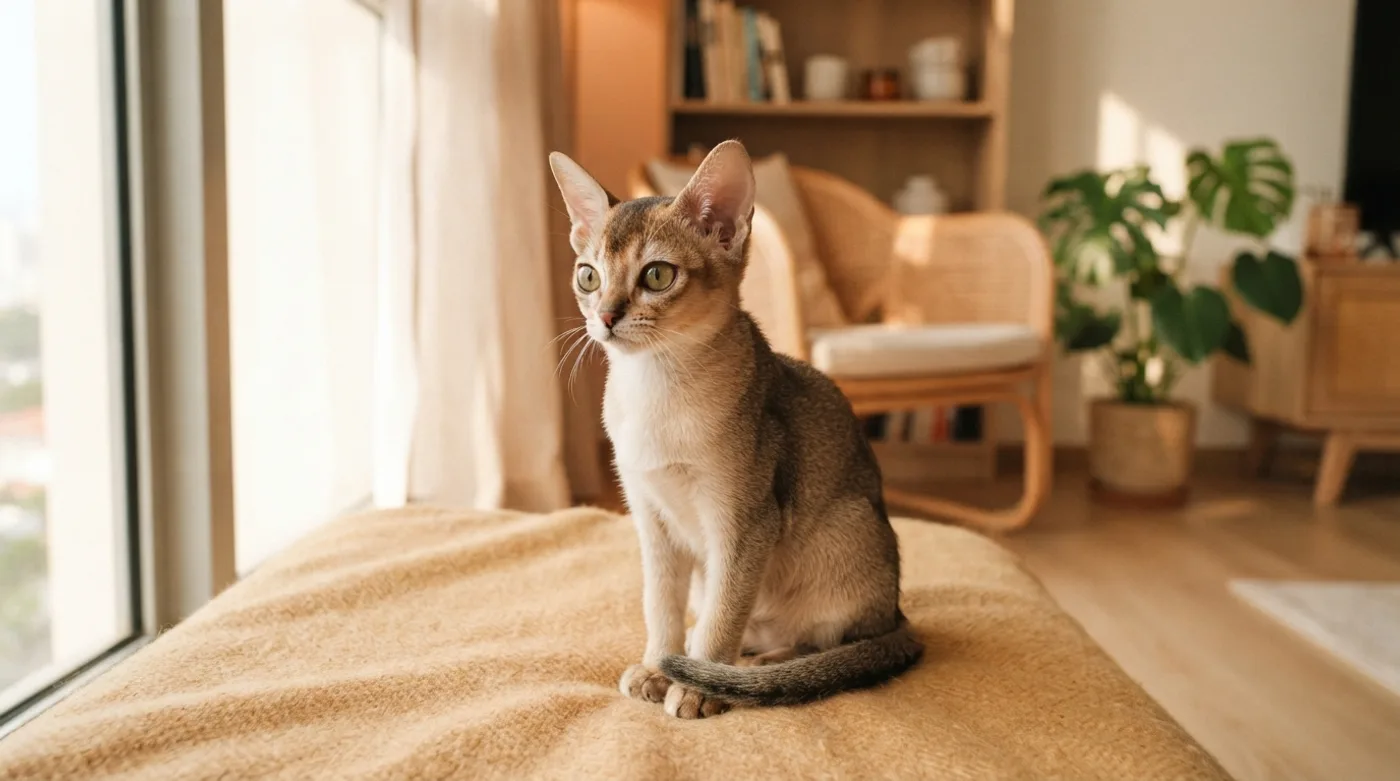
The Singapura is routinely described as the smallest recognised cat breed in the world. Adults commonly weigh somewhere around two to three and a half kilograms — noticeably lighter than an ordinary domestic cat — and the impression up close is of a cat built at about four-fifths scale.
The look is unmistakable. A short, close-lying coat in a single recognised colour: a warm sepia agouti, where each individual hair carries alternating bands of dark and light, so the coat appears to shimmer as the cat moves. Over that, oversized eyes and oversized ears on a small, compact, surprisingly muscular frame. It reads as kitten-like well into adulthood, and that impression is not entirely misleading — Singapuras keep a young cat's curiosity for years.
Temperament is what owners talk about most. They are people-oriented to the point of nosiness: on the counter you are working at, in the box you are packing, involved in whatever is happening rather than observing from a shelf. For a household that wants an interactive cat, that is the appeal. For one that wants a decorative, independent cat, it is not.
Practically, the short single-colour coat means grooming is close to nothing — a weekly once-over is generous. Our Singapura breed guide covers day-to-day care and what the breed costs when it does come up locally.
Small is not fragile
A Singapura is a compact, athletic cat that climbs everything. It needs the same meshed windows and vertical space as any other cat in a high-rise flat.
The Kucinta story
In the early 1990s Singapore adopted the Singapura as a tourism mascot, and a public naming contest produced the name Kucinta — a blend of the Malay words kucing, cat, and cinta, love. Worth being precise about: Kucinta is the name of the mascot, not a second name for the breed.
What made the association stick was not the marketing. It was the sculpture. A group of bronze cats set along the Singapore River — the Kucinta cats — turned an abstract mascot into something people walk past, photograph and touch. Public art outlives campaigns, and thirty-odd years later the statues are still there while the campaign is a footnote.
The story attached to the mascot was irresistible and did much of the work: the humble drain cat of the old river, small and scrappy and overlooked, elevated into a national symbol. It is a very good story about Singapore as much as about a cat, which is part of why it travelled so far and why it is repeated almost verbatim on nearly every page written about the breed.
It is also, as it happens, contested — which the next section takes seriously rather than skipping, because it is the part almost nobody publishes.
The origin story, honestly
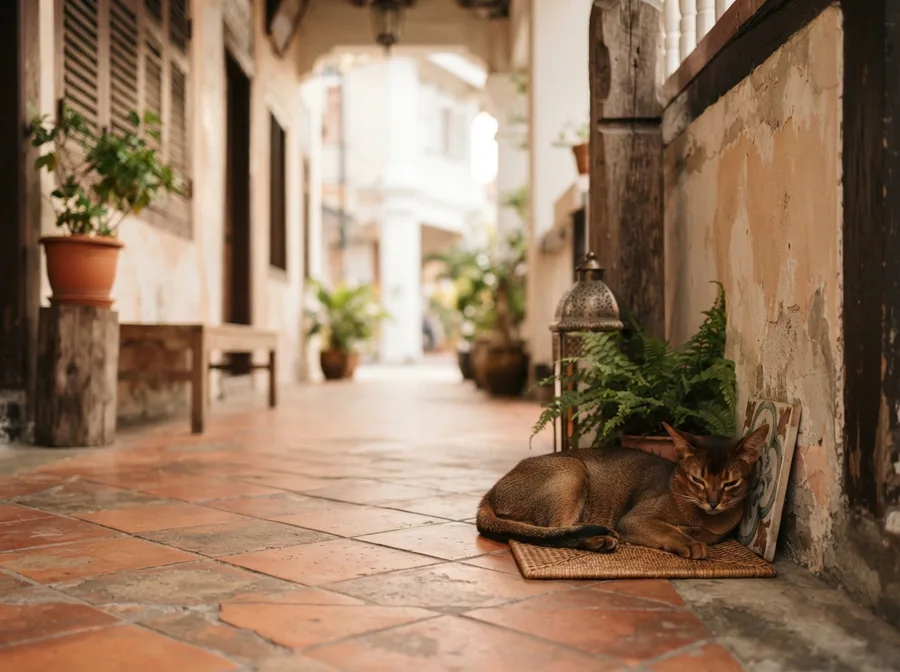
The traditional account is that the breed descends from small ticked cats found around the drains and riverside of Singapore, taken to the United States by American breeders in the 1970s and developed there into a recognised breed.
That account has been disputed since around 1990, when claims surfaced that the founding cats had not been picked up on Singapore streets at all, but had been brought to Singapore from the United States and later presented as local finds. The Cat Fanciers' Association held a formal investigation into the matter. The breed retained its recognised status, and the question of exactly where those founding cats came from was never conclusively resolved to everyone's satisfaction.
Genetic work has complicated the picture rather than settling it. Broad surveys of cat-breed genetics published in the late 2000s found the Singapura to be very closely related to the Burmese, and to carry unusually low genetic diversity — consistent with a small founding population, and hard to reconcile with a straightforward "random street cats" origin.
None of which makes the Singapura less of a cat, or less genuinely tied to Singapore: a breed that has been a national symbol for three decades has a real relationship with the place regardless of how its first few individuals got on a plane. But you will read the drain-cat story stated as flat fact on a great many pages, and it is more honest to say that the origin is contested, that the cat fancy investigated it, and that the genetics point somewhere more complicated.
Why this matters practically
A small founding population means low genetic diversity. That is a health question to raise with any breeder, not merely a historical curiosity.
The breed in numbers
What makes it distinctive, and the two rows that make it hard to find.
The last two rows explain each other. A breed with small litters and a small global breeding population does not produce many kittens in any given year, and Singapore has very few breeders working with it despite the name.
That scarcity is also the main thing setting the price when one does come up. The usual within-breed price drivers barely apply when the standard recognises a single colour and there is nothing to choose between.
Key numbers
- Adult weight
- Around 2–3.5kg
- Coat
- Short, close-lying, ticked
- Colour
- One — sepia agouti
- Features
- Large eyes, large ears
- Grooming
- Minimal
- Temperament
- Lively, curious, people-led
- Litter size
- Typically small
- Availability here
- Rare
Living with one in a Singapore flat
On the specifications, close to an ideal flat cat. With one caveat.
Take the attributes at face value and the Singapura looks purpose-built for HDB living: physically tiny, so it takes up very little of a small flat; short-coated, so grooming and shedding are minimal; and strongly bonded to its people, which suits a household that is actually home.
The caveat is energy. This is not a placid lap cat that will sleep through a working day without complaint. A Singapura alone in an empty flat for eleven hours needs the flat itself to be interesting, or it needs company — and since the HDB cap is two cats, a pair is a legitimate plan rather than an escalation.
Everything else is the standard Singapore cat setup, which applies to a two-kilogram cat exactly as much as to a seven-kilogram one.
Checklist
- Mesh every openable window and the balcony — small and athletic is not the same as cautious
- Vertical space — a cat tree and shelves; this breed climbs everything you own
- Two proper play sessions a day, each ending in a catch and then food
- Puzzle feeding for the hours you are out
- Consider a second cat if the flat is empty all day
- Microchip and licence — free until 31 August 2026
- Ask about health screening and how closely related the parents are
Finding one, without being taken in
A rare, famous, expensive breed is exactly the profile that attracts misrepresentation.
- 1Know what you are looking forOne recognised colour, a very small adult size, a ticked sepia coat. A "Singapura" offered in several colours is not what it is being called.
- 2Expect to waitSmall litters and few breeders mean availability is measured in months. Anyone with Singapura kittens permanently on hand deserves a second look.
- 3Verify the licenceOnly AVS-licensed sellers may legally sell pets in Singapore. Ask, and check against AVS guidance before any payment.
- 4Ask about registration and pedigreeA genuine pedigree Singapura comes with registration papers naming the parents. Ask to see them, and ask which registry issued them.
- 5Ask the genetic-diversity question directlyHow closely related are the parents, and what screening has been done? A serious breeder answers readily; it is the central question for this breed.
- 6Meet the mother and the setupThe single most informative thing you can do — and the step a misrepresented "Singapura" tends not to survive.
- 7Take the records at collectionMicrochip number, vaccination card, health records. Then register the chip to you and license the cat.
The full version of this assessment is in how to choose a breeder in Singapore, and it applies with extra force to a scarce breed where the buyer usually knows less than the seller.
If you love the story more than the pedigree
There is an honest middle path that a lot of Singapura admirers end up taking.
The look is not exclusive
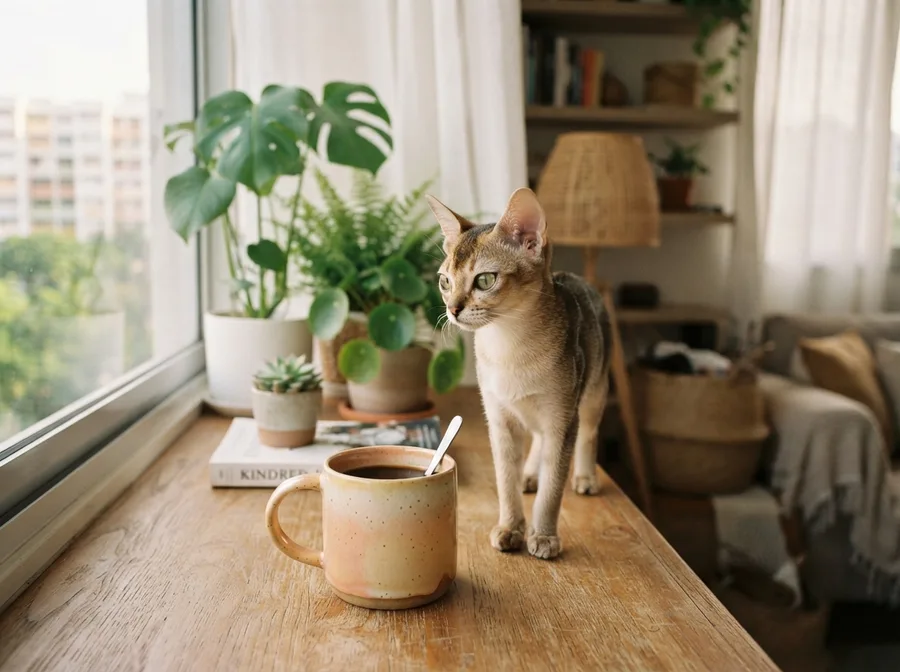
Small ticked brown cats are common in Singapore's community-cat population. A local moggie can carry much of the visual character without a pedigree or a waiting list.
Adoption
Shelters and rescuers here rehome hundreds of cats, and many are exactly the small, lively, sociable type the story is about. See adopting a cat in Singapore.
Other small breeds
If size is the appeal, other compact breeds are far easier to find here. Compare them in the full breed index.
Other flat-friendly breeds
If the real appeal is "great cat for a small flat", the field is wider than one rare breed — see breeds suited to HDB living.
Visit the statues
The Kucinta cats by the Singapore River cost nothing and are genuinely charming. A better introduction to the story than most articles about it.
Be patient if it must be a Singapura
Waiting for a properly bred kitten from a licensed source is always a better outcome than taking the first cat someone calls a Singapura.
Whatever cat you end up with
The paperwork and the preparation do not vary by breed or by price. A Singapura, a British Shorthair and a community moggie all need the same flat and the same fortnight.
Mesh every openable window and the balcony before the cat arrives — the room-by-room walkthrough covers it. Set up trays, a carrier, scratching posts and vertical space in advance. Book a vet appointment for the first week. And do the licensing while it costs nothing: microchip registered to you, then apply through PALS, free until 31 August 2026. The licensing walkthrough and what the Cat Management Framework requires cover the rest.
Then, for a fortnight, do less than you want to. One quiet room, familiar food, short calm visits. bringing your kitten home covers the settling method — which works the same way for the smallest recognised breed in the world as for anything else.
The cat itself, and the argument about where it came from
Two things make the Singapura unusual: an unmistakable coat, and an origin story that has been contested for more than thirty years.
Start with the cat, because the physical description is not in dispute. The Singapura is generally cited as the smallest breed of domestic cat — Guinness World Records has recorded it as such — and it is defined by three features: outsized eyes and ears on a small frame, a warm sepia-toned ticked coat in which each individual hair carries bands of light and dark, and a blunt tail. The ticked coat is the part that photographs badly and reads unmistakably in person; it is the same agouti patterning you see on Singapore’s street cats, which is precisely why the origin question became interesting.
The accepted account is that Hal and Tommy Meadow returned to the United States in 1975 with three brown-ticked cats they described as local Singapore street cats, and that the breed was developed from those three. The name is the Malay word for Singapore.
In 1990 that account came apart. Records held by the Primary Production Department and the Singapore Cat Club showed that the Meadows already had the three cats when they arrived in Singapore in 1974 — in other words the founding cats had been born in America and taken to Singapore, not found there. Tommy Meadow acknowledged it, and the explanation offered was that dates had been altered to conceal an earlier trip. The Cat Fanciers’ Association investigated and concluded that no wrongdoing had occurred, and the Singapura retained its status as a natural breed.
One detail is worth keeping in view because it cuts the other way. In 1980 a female cat named Chiko was found at the SPCA in Singapore and imported to the United States by the breeder Barbara Gilbertson, and she joined the breeding programme. Whatever the paperwork said about the original three, Chiko demonstrated that cats matching the Singapura description genuinely did live on Singapore’s streets.
The consequence for anyone thinking about owning one is not historical, it is genetic. A breed founded on a handful of cats has a narrow gene pool, and a narrow gene pool concentrates inherited conditions more readily than a broad one. That is the reason to ask a Singapura breeder about lineage and about screening rather than about the story — and the reason the honest recommendation for someone who simply likes the look is to visit a shelter, where small brown-ticked cats descended from the same street population turn up regularly.