
The one thing that matters more than everything else
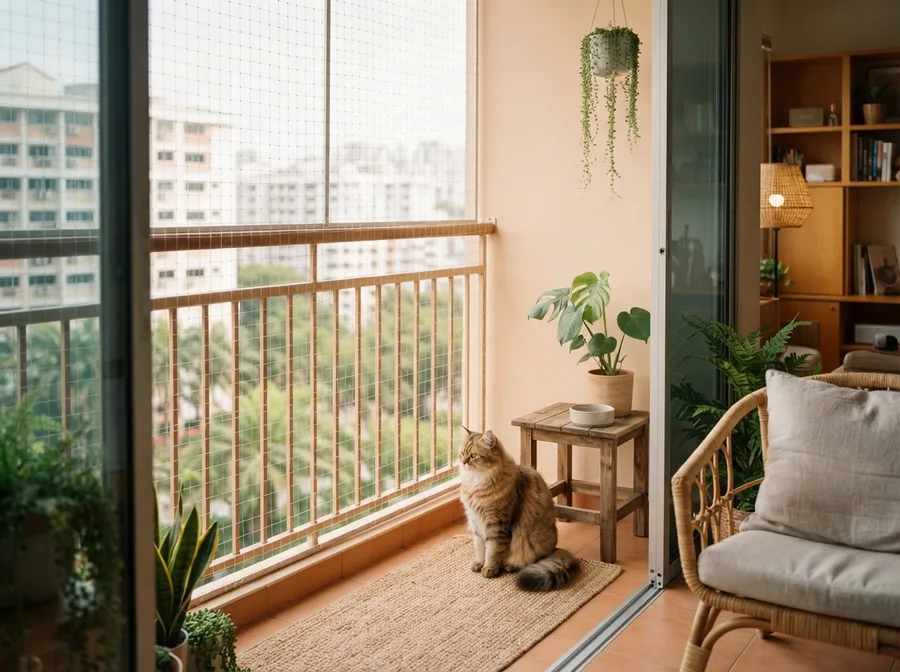
Cat-proofing a Singapore flat has a hierarchy, and it is extremely top-heavy. Window and balcony mesh is not the first item on a list of twenty. It is the item, and the other nineteen are housekeeping.
The reason is arithmetic. Almost every serious, sudden, irreversible thing that happens to a cat in a Singapore flat is a fall. The rest of the risks on this page — a chewed cable, an eaten lily, a swallowed hair tie — are real and worth preventing, but they mostly present as a vet visit. A fall from the eleventh floor does not.
It is also worth being clear about the mechanism, because "cats always land on their feet" does real damage as a belief. Cats fall while distracted: tracking a bird, startled mid-leap, misjudging a wet ledge, or trying to reach something on the outside of a grille. The cat is not making a decision about the drop. It is making a decision about the bird.
The Cat Management Framework frames all of this as responsible ownership rather than a specific numbered rule — see AVS. In practice, in a high-rise, responsible ownership and full mesh are the same sentence.
Do this before the cat arrives
Mesh installed after a near-miss is mesh installed too late. Book it in the same week you commit to a kitten, not the week it comes home.
Meshing, done properly
Five decisions, in the order an installer will ask you about them.
- 1Cover every opening, not most of themBedrooms, living room, kitchen, bathroom, service yard, balcony. A cat systematically explores a flat within its first fortnight and will find the one window you left.
- 2Choose a gauge that survives clawsFine insect netting is not cat mesh. You want something a cat can hang its full weight on and dig into without stretching or tearing at the frame.
- 3Check the fixing, not the fabricMesh almost never fails in the middle. It fails at the edge, where an adhesive strip lets go in the heat and humidity. Screwed or clamped frames outlast stuck-on ones here by a wide margin.
- 4Keep an escape route for peopleAt least one meshed panel per room should open from the inside for fire safety and ventilation. Say this to the installer explicitly.
- 5Re-inspect twice a yearSun and rain age everything on a Singapore facade. Push on each panel, check every corner fixing, and look for sag along the bottom edge where a cat leans.
One more thing worth saying out loud: mesh is not a substitute for closed windows during the first fortnight. Give a new cat time to learn the flat before it learns the ledge.
Room by room, before the carrier opens
A walk-through in the order the cat will do it.
Cats explore vertically and they explore gaps. Do this walk-through crouched at cat height, and look specifically for two things: places a small animal could get into, and places something could fall from.
The kitchen deserves particular attention in a Singapore flat, because it usually contains the service-yard door, the hob, and the bin — three of the top five hazards in one room.
Checklist
- Living room — secure the TV and any tall shelving to the wall; cats climb what wobbles
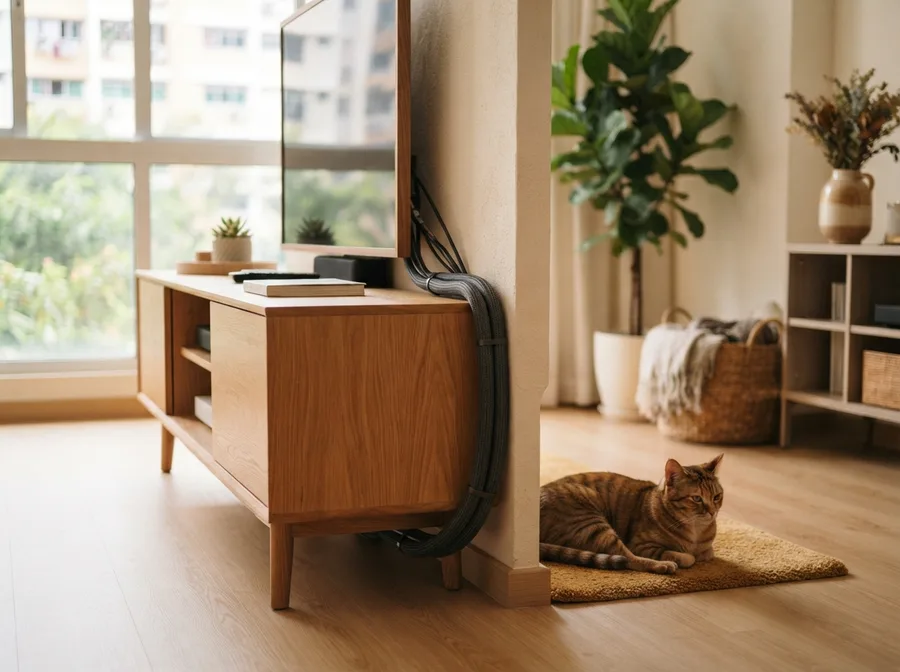
- Cables — sleeve or clip everything at floor level; kittens chew charger cables specifically
- Kitchen — induction and gas knobs covered or locked; a cat on a hob is a fire risk, not a photo
- Bin — a lidded, weighted bin; cooked bones, string and cling film are all emergency-room material
- Service yard — mesh the opening and check the drying-rack gap, which is a favourite
- Bathroom — lid down, cleaning products behind a door, and no bucket left full
- Washing machine and dryer — door shut, always, and check inside before every cycle
- Small objects — hair ties, rubber bands, dental floss, sewing thread; linear foreign bodies are a surgical problem
- Gaps — behind built-ins, under the sofa, into the bomb shelter; block anything a cat can enter but not reverse out of
- Balcony — meshed floor to ceiling, and nothing stacked against the railing to climb
Plants, foods and chemicals
The slower hazards. These are the ones that arrive as a gift or a delivery after the flat is already sorted.
Lilies — the serious one
Every part of a true lily is highly toxic to cats, pollen included. A bouquet on the dining table is enough. If someone sends flowers, check before they come inside.
Common houseplants
Pothos, monstera, dieffenbachia, philodendron, sago palm and dracaena all appear in Singapore homes and all range from irritant to dangerous. Unidentifiable plant, no plant.
Human food
Onion, garlic, chives and shallots — so most of what makes local cooking taste like local cooking. Also chocolate, grapes, raisins, alcohol and xylitol.
Essential oils
Diffusers produce sustained exposure in a sealed, air-conditioned flat. Cats cannot leave the room. Treat them as unsafe around cats.
Cleaning products
Concentrated floor cleaners and anything phenolic are a problem, and cats walk on treated floors and then groom their paws. Rinse, ventilate, and keep the cat off until dry.
Pest control
Rodenticides and insecticides used in common areas or by a contractor are outside your control. Ask before scheduled fogging and keep the cat in a closed room with the windows shut.
The front door problem
Once the windows are meshed, the highest-probability escape route in a Singapore flat is the front door — and it is the one nobody plans for, because it does not feel like a hazard.
The pattern is always the same: the metal gate is open, the inner door is open, someone is signing for a parcel or holding a bag of groceries, and a curious cat walks into a corridor it has never seen. Indoor cats do not navigate corridors. They tend to go somewhere dark and stay there, which is why a cat lost inside its own block can take days to find.
The fix is a habit, not a product. Treat the entrance as an airlock: the inner door stays shut while the gate is open, and vice versa. Deliveries and visitors get met with the cat already behind a closed bedroom door. Anyone who comes regularly — helper, family, contractors — needs to be told the rule out loud, once, rather than expected to infer it.
This is also the strongest practical argument for a microchip that is registered to your current phone number. Everything in this section is about probability; the chip is what you have left when probability does not go your way. Chipping and registration covers it.
Renovation, moving and other high-risk weeks
Ordinary weeks are safe once the flat is proofed. These are not ordinary weeks.
The common thread is that a proofed flat becomes an unproofed flat the moment a stranger with a toolbox is in it. On any day with contractors, the cat belongs in one closed room with food, water, a tray and a note on the door — not "supervised", which lasts until the first time you look away.
The same applies to the fortnight after a house move. Everything the cat knows has changed, the flat is full of boxes to hide behind, and the front door opens twenty times a day. Keep the cat confined to one prepared room until the unpacking is finished; it is better for the cat and considerably better for your nerves. Our guide to settling a cat into a new home covers the one-room method in full.
Key numbers
- Moving day
- Doors propped, cat in one shut room
- Renovation
- Mesh may be removed — verify daily
- Aircon servicing
- Windows opened without warning
- Pest fogging
- Ask the schedule; seal the flat
- Festive season
- Lilies, tinsel, string, open doors
- Long trips
- Brief the sitter on the door rule
Proofed is not the same as good to live in
A perfectly cat-proofed flat with nothing to do in it produces a bored cat, and bored cats generate their own hazards: they get into the cabinet you did not latch, they chew what they can reach, and they redirect energy onto furniture and, occasionally, onto you.
So the second half of cat-proofing is giving the cat somewhere legitimate to put all that. Vertical space, a scratching post it actually prefers to the sofa, a window perch behind that new mesh, and food that arrives through some kind of puzzle rather than in a bowl at once. Enrichment in a small flat covers the practical version of this for a two- or three-room layout.
And if the cat is not chosen yet, cat-proofing is easier when the cat suits the home. A calm, adaptable cat needs less containment than an athletic one that will find the top of every cabinet on day two. Which breeds suit an HDB flat gives a straight verdict breed by breed.
If something is eaten
Do not wait to see how it goes. Call a licensed Singapore vet immediately, and take the plant, packet or label with you — identification changes the treatment.
Cat proofing options: DIY, no-drill and professional installation
The mesh question has three answers depending on whether you own the flat, rent it, or need it done this weekend.
Start with what you are meshing against. An HDB window with an invisible grille is not cat-proof: invisible grilles are spaced for people and views, and the gap spacing between the cables is wide enough for a kitten to pass through and for an adult cat to try. Grilles solve the human falling problem, not the cat one. What makes an opening safe is a mesh with an aperture small enough that a cat cannot get its head through, fitted so that it cannot be pushed out of its frame by a cat leaning on it.
Professional installation is the route most owners end up taking, and for a whole flat it is the one that gets the frames, the tension and the awkward openings right — kitchen windows, bathroom vents, the service yard, and the gap above a sliding panel. Ask specifically about aperture size and about how the frame is fixed, because a well-made mesh in a badly fixed frame fails in the same way as no mesh.
A renter has a different problem: drilling. No-drill options exist — tension-mounted frames, clip-on panels sized to the window recess, and magnetic frames that seat against the existing metalwork — and a DIY approach with rigid mesh panels cut to the recess and secured with removable fixings is genuinely workable for a small flat. Two rules if you go that way: test every panel by pushing it hard from the inside before you trust it, and check it monthly, because adhesive and tension both fail quietly.
Then the things that are not windows. The main door is where most escapes actually happen — a cat learns the delivery routine faster than you do, so treat the entrance as an airlock and put a barrier or a second door between the cat and the corridor if your layout allows it. Cords from blinds and chargers get chewed and are worth sleeving or clipping out of reach. And toxic plants come out of the flat entirely rather than being moved somewhere high: lilies are the serious one, and a cat that knocks a vase over does not need to eat much.
Worth knowing before you plan the budget: meshing is frequently an adoption condition rather than a recommendation. Welfare groups and independent fosterers routinely ask to see meshed windows at the home visit, so if you are adopting, this is work that happens before the cat arrives, not after.
Checklist
- Mesh aperture small enough that a cat cannot get its head through
- Invisible grille gap spacing is not cat-proof on its own
- Kitchen, bathroom, service yard and the gap above sliding panels all count
- Renting? No-drill tension, clip-in or magnetic frames — tested by pushing hard
- Main door treated as an airlock, especially at delivery time
- Cords sleeved; lilies and other toxic plants out of the flat
- Re-check DIY fixings monthly — tension and adhesive fail quietly