Why the chip comes first
Microchipping is not a nice-to-have that responsible owners add on. Under the Cat Management Framework it is a requirement, and it is a sequencing requirement: the licence is issued against the microchip number, so the chip has to exist before the application can be made.
That is why "microchip, then license" is the order everywhere on this site and on the AVS pages. People who try it the other way round discover the form asks for a number they do not have.
The second reason is the one that matters at 11pm when a cat has slipped out of a front door. A collar comes off. A photo in a WhatsApp group depends on someone recognising a tabby among the several thousand other tabbies in Singapore. A microchip is the only identification a cat cannot lose, and it is the first thing a vet or a shelter checks.
The official requirement is set out on the AVS licensing requirements page, and the framework itself on the AVS cat licensing page.
The chip is not a tracker
It has no battery, no signal and no location. It stores a number a scanner can read. That number is only useful if it is registered to contact details that are currently yours.
What the procedure actually involves
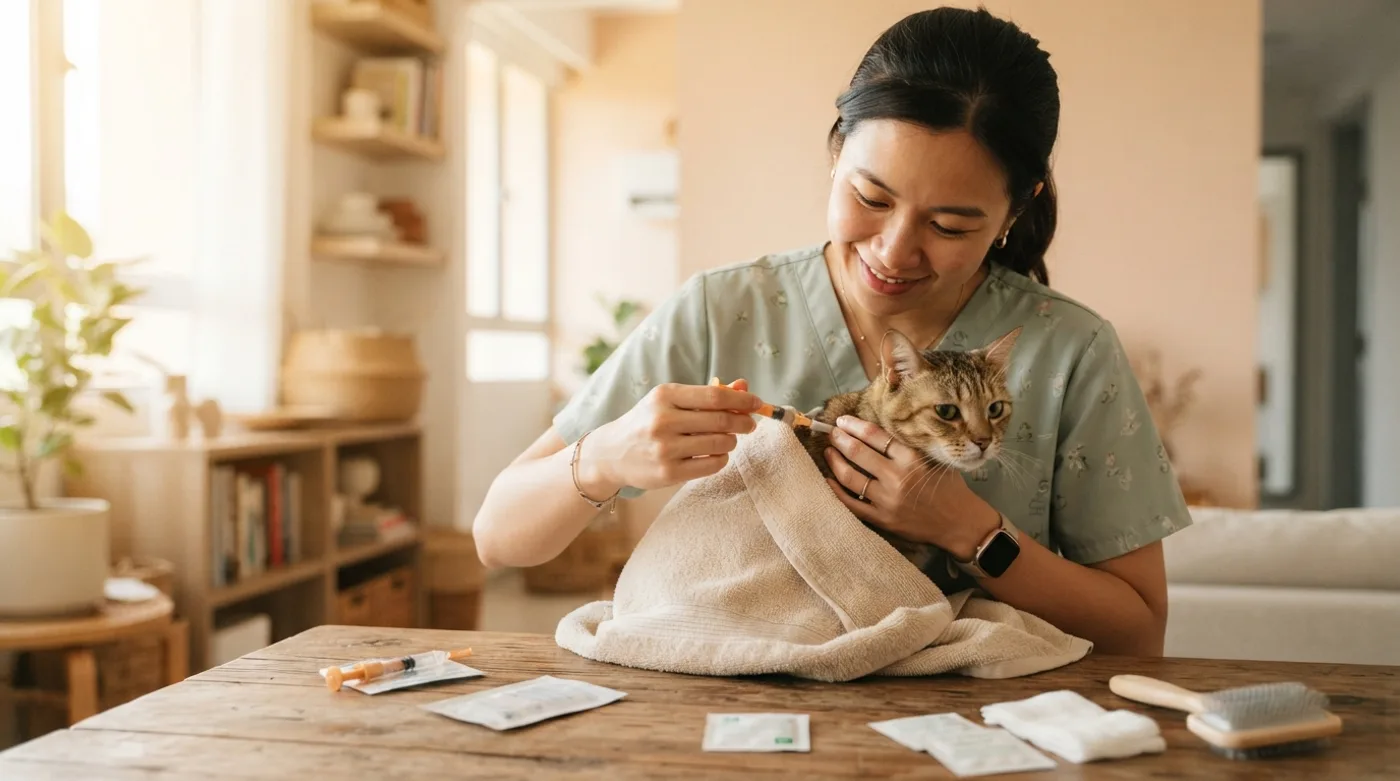
The chip is about the size of a grain of rice, sealed in biocompatible glass, and implanted under the loose skin between the shoulder blades with a single-use needle. There is no anaesthetic, no shaving and no stitches.
From the cat's point of view it is a firm pinch. Most kittens complain about being held still rather than about the implant, and most are back to normal within a minute. The needle is wider than a vaccination needle, which is why some vets do it during a vaccination visit while the cat is already settled on the table.
Once implanted, the chip needs no charging, replacing or maintaining. It is passive: no power source, inert until a scanner passes over it and induces just enough current to read the number back. That is the whole technology.
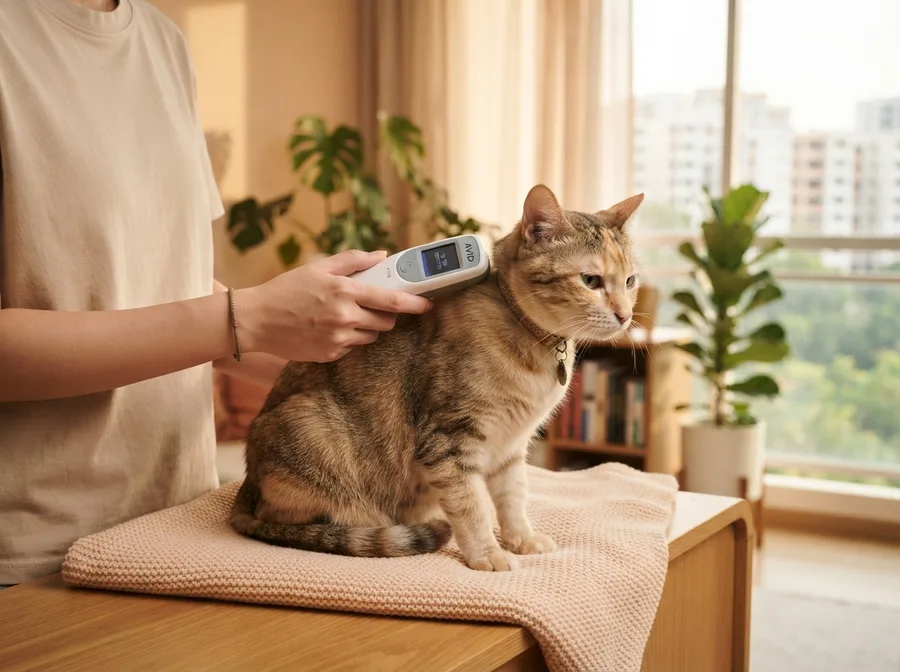
Migration — the chip drifting a few centimetres from where it was placed — is uncommon but possible, which is why a scan check at the annual vet visit is worth thirty seconds of the appointment. Ask for it. Vets do not usually offer unprompted.
The registration step nearly everyone skips
Implanting the chip is the easy half. This is the half that decides whether it ever works.
- 1Get the number in writingOn the day of implanting, or on the day you collect a pre-chipped kitten. A chip certificate, an invoice line, or a photo of the record — anything you will still be able to find in three years.
- 2Check it scansAsk the vet to scan and read it aloud against the paperwork. Transposed digits on a handwritten record are more common than you would like, and they are only discoverable at exactly this moment.
- 3Register it to youThe number has to be linked to your name, address and a phone you actually answer. If the kitten was chipped by a breeder, the registration starts in the breeder's name and stays there until someone transfers it.
- 4Use it to apply for the licenceEnter the number on the licence application at pals.avs.gov.sg. Licensing is free until 31 August 2026.
- 5Update it whenever life changesNew flat, new phone number, new owner. Each one breaks the chain if it is not recorded, and each one is a five-minute job at the time and an impossible one afterwards.
The failure case is worth stating plainly, because it is the ordinary one: a cat is found, taken to a vet, scanned successfully, and the number returns a person who has moved twice and changed carrier. Everything worked except the part nobody maintained.
Buying a kitten? Ask these at collection
Before money changes hands and before the carrier is in your car.
A licensed Singapore breeder will answer all of these without hesitating, because they have answered them a hundred times. Hesitation on any of them tells you considerably more about the seller than the photographs on their website do.
This is also a quiet legitimacy check. Only AVS-licensed sellers may sell pets in Singapore, and a seller who cannot produce a chip number is a seller whose paperwork deserves a much closer look. We cover the rest of that assessment in vetting a breeder properly.
Checklist
- Is the kitten microchipped? — if not, why not, and when is it scheduled
- What is the number? — in writing, and scanned in front of you
- How do I transfer the registration to my name? — the answer should be immediate
- Which vet implanted it, and when? — it should be on the health record
- Does the vaccination card carry the same name and number? — mismatches are worth asking about
- Has the licence already been applied for? — some breeders start it; most leave it to you
What it costs, and what it buys
One of the few genuinely cheap things in cat ownership.
Against the rest of a cat's life — food, litter, annual vet visits, sterilisation, a dental extraction somewhere around year eight — microchipping is a rounding error. It sits in the one-off setup layer alongside the carrier and the window mesh, and it is the cheapest item in that layer by a wide margin. The full cost picture puts it in context.
What it buys is narrow but absolute: on the day a cat is found by someone else, the chip is the difference between a phone call and a shelter listing.
Key numbers
- The chip
- A one-off vet charge
- The implant
- No anaesthetic, no follow-up
- Lifespan
- The life of the cat
- Registration update
- Free — and the part that matters
- Licence
- Free until 31 Aug 2026
- Without it
- No licence is possible
The indoor-cat objection, answered
"My cat never goes out" is the most common reason people delay — and indoor cats are exactly who this is for.
The front door
Deliveries, movers, a propped-open gate on a hot afternoon. Most escapes in Singapore flats happen at the front door, not the window.
Unfamiliar ground
An outdoor cat that gets out knows the neighbourhood. An indoor cat does not, and tends to freeze somewhere it cannot be seen rather than come home.
No collar survives
Breakaway collars are designed to come off — that is the safety feature. The tag goes with it. The chip stays.
Renovation and moving
The highest-risk weeks of a cat's life are the ones with contractors, open doors and boxes. They are also the weeks people forget to update the address.
It is required anyway
The licence cannot be issued without it, so the real choice is not whether to chip but whether to do it now while licensing is free.
Vets scan reflexively
Any cat presented as a stray at a Singapore clinic is scanned. That single reflex is the whole return system, and it only works if there is something to find.
Where this fits in the paperwork
Microchipping is step one of a short chain most new owners complete in a single week and then never think about again: chip the cat, register the chip to you, take the free Pet Ownership Course if you are a first-time applicant, and license through PALS.
Our walkthrough of the licence application covers the rest of that chain step by step, including what changes when fees begin on 1 September 2026. If you are new to keeping a cat in public housing more generally, the HDB rules for cat owners covers the two-cat cap, mesh and the neighbour-facing side of it.
And if the chipping has not happened yet because the kitten has not been chosen yet, that is the right order too. Ask about the chip while you are still choosing the breeder — the answer is diagnostic.
Confirm before you act
Requirements change. Check the current position with AVS, and speak to a licensed Singapore vet about your own cat.
Mandatory, subsidised in places, and the reason it matters most
Microchipping is not an optional extra under the Cat Management Framework, and the licence depends on it.
Microchipping a pet cat is mandatory under the framework, and the sequence matters: the chip comes first, because the cat licence is issued against the chip number. Practically that means a cat cannot be licensed until it has been chipped and the chip has been registered, and the licence is required once the cat reaches three months of age. Licensing is free until 31 August 2026, so the only thing standing between most owners and a licensed cat is a chip and ten minutes on PALS.
The procedure itself is unremarkable — a chip the size of a grain of rice, implanted between the shoulder blades, done in seconds without anaesthetic. If the cat is being sterilised anyway, ask for both in the same visit while it is already under: same outcome, one recovery, one bill.
Cost varies by clinic, and there is assistance to look for rather than assume. AVS has run microchipping drives, and welfare organisations including Cat Welfare Society have organised subsidised or assisted sessions, particularly aimed at community cats and at households that would otherwise struggle with the cost. What is running at any given time changes, so ask your clinic and check with the welfare groups rather than working from an old forum post — and if a subsidy exists, it is worth the wait rather than skipping the chip.
An adopted cat has usually been chipped already, which raises the step people miss. A chip is registered to whoever registered it, so an adopted cat still carries the shelter’s or the fosterer’s details until you change them. Transfer the registration into your name on the day you get the cat, and confirm the number by having it scanned in front of you rather than reading it off a form.
Which brings up the reason any of this matters beyond compliance. A lost cat in a high-rise estate is found by a stranger, a cleaner or a vet, and the only thing connecting it back to you is a chip whose registration is current. An unchipped cat that gets out is a cat you are looking for on Facebook. A chipped one with the wrong owner on the record is very nearly as bad.