Why a flat can be enough, and when it is not
Almost every cat in Singapore lives entirely indoors, and that is the right call — the alternative involves roads, other animals and a lift lobby. The question is not whether an indoor life is acceptable. It is whether the indoor life you have built is interesting.
Cats do not experience territory the way we experience square footage. A cat evaluates a space by how many distinct levels it has, how many vantage points overlook the room, how many places it can be hidden but not cornered, and how much of the day contains something to investigate. A sparsely furnished four-room flat can be a duller territory than a well-built two-room one.
That reframing is the whole of this page. You are not compensating for a small flat. You are building vertical territory, a hunting routine and a feeding pattern into a space that would otherwise be flat, static and predictable.
And there is a plain diagnostic for whether it is working. A cat with enough to do sleeps a great deal, eats normally, and produces short bursts of dramatic activity. A cat without enough to do produces behaviour: over-grooming, night yowling, ankle ambushes, and furniture destruction in the middle of a room rather than at its edges.
Boredom does not look like sadness
It looks like a behaviour problem. Most "my cat has become difficult" conversations in Singapore flats are enrichment conversations wearing a different hat.
Build upwards first
The single highest-return change in a small flat is vertical. Floor space is what you are short of; wall space is what you have.
A tall cat tree near a window is the obvious starting point, and it earns its footprint several times over: it converts a square metre of floor into four or five levels, it puts a cat above the traffic of a busy room, and it gives an approved tall thing to climb so the bookcase stops being the tall thing.
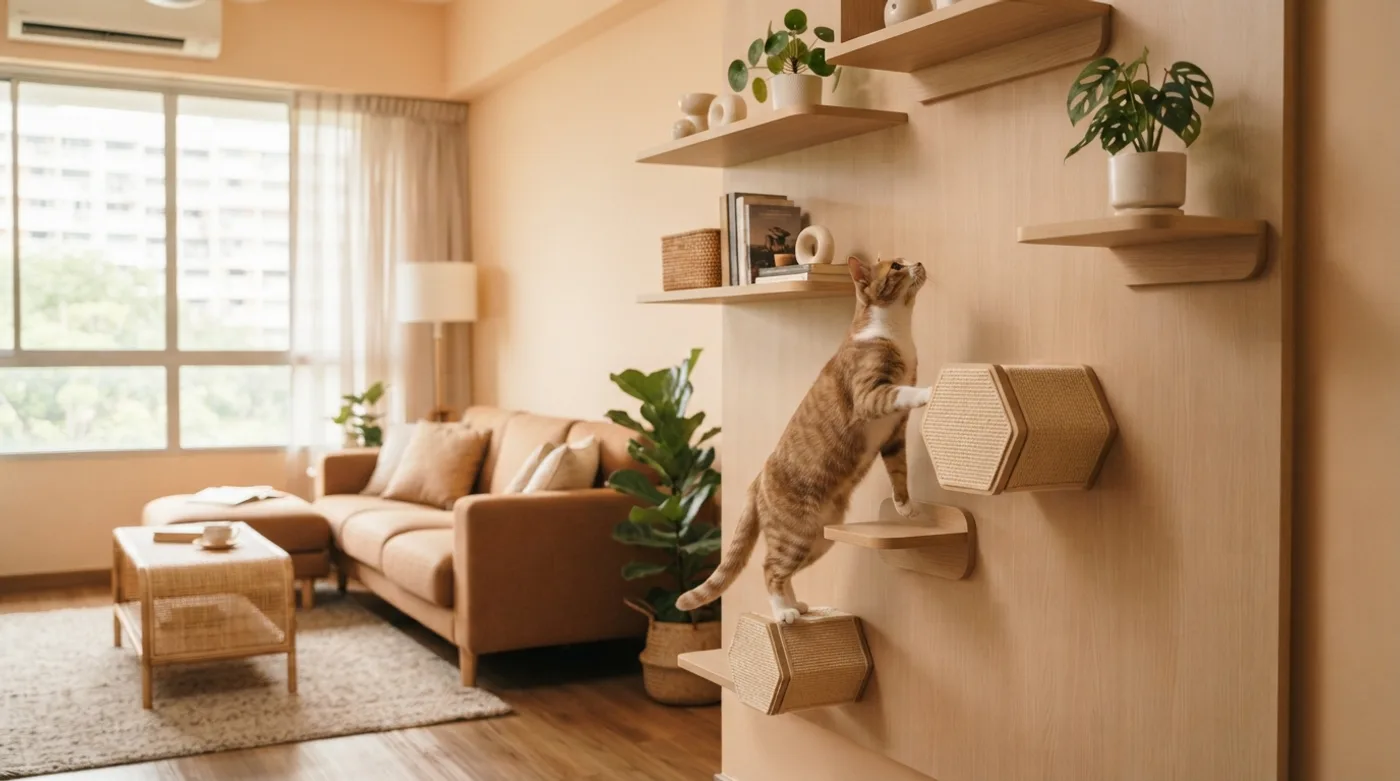
Wall shelves extend the same idea without using any floor at all. The trick is spacing — the jumps need to be comfortable for an adult cat rather than impressive for a young one, and every route needs an exit at both ends so a cat is never trapped up there by another cat or a vacuum cleaner. Aim for a loop rather than a dead end.
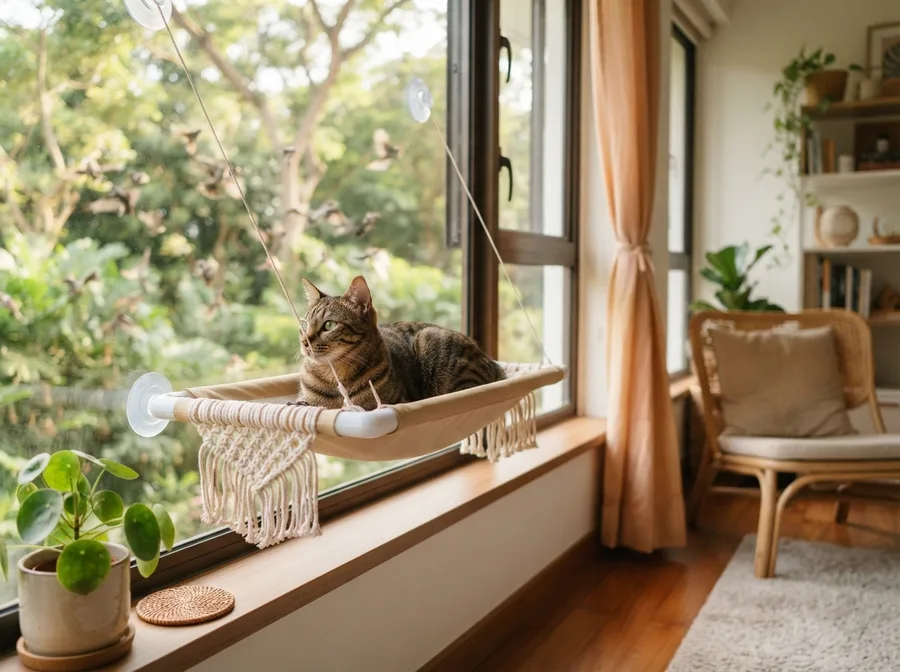
And put a perch at the window. Behind mesh, a window is the highest-value piece of enrichment in a Singapore flat and it costs nothing to run: birds, weather, the block opposite, people at the lift lobby. Cats will watch it for hours. If a window with a view is available in your flat, that is where the perch goes, regardless of where it looks best.
Play that actually satisfies a cat
The hunt has a shape. Play that skips the ending leaves the cat wound up rather than settled.
- 1StalkMove the toy away from the cat and let it disappear behind furniture. Prey that flees and hides triggers far more interest than prey waved in a cat's face.
- 2ChaseShort, erratic bursts with pauses. Real prey stops, freezes and bolts. Continuous dragging in a circle is the fastest way to lose a cat's attention.
- 3Pounce and catchLet the cat win, several times. This is the step laser pointers cannot provide, and its absence is why laser-only play leaves some cats agitated.
- 4Kill and dispatchThe rabbit-kicking, biting, hugging phase. Let it finish rather than pulling the toy away to keep the game going.
- 5FeedMeal or a decent treat immediately after. Hunt, eat, groom, sleep is the natural sequence, and closing it is what turns play into a nap instead of into zoomies.
Twice a day, ten to fifteen minutes each, is more valuable than an hour of low-grade attention. The evening session matters most in a flat — a cat fed and satisfied at 10pm is considerably less likely to be sprinting across your chest at 4am.
Make the food do some work
A bowl delivers a day's calories in ninety seconds. That is a lot of wasted opportunity.
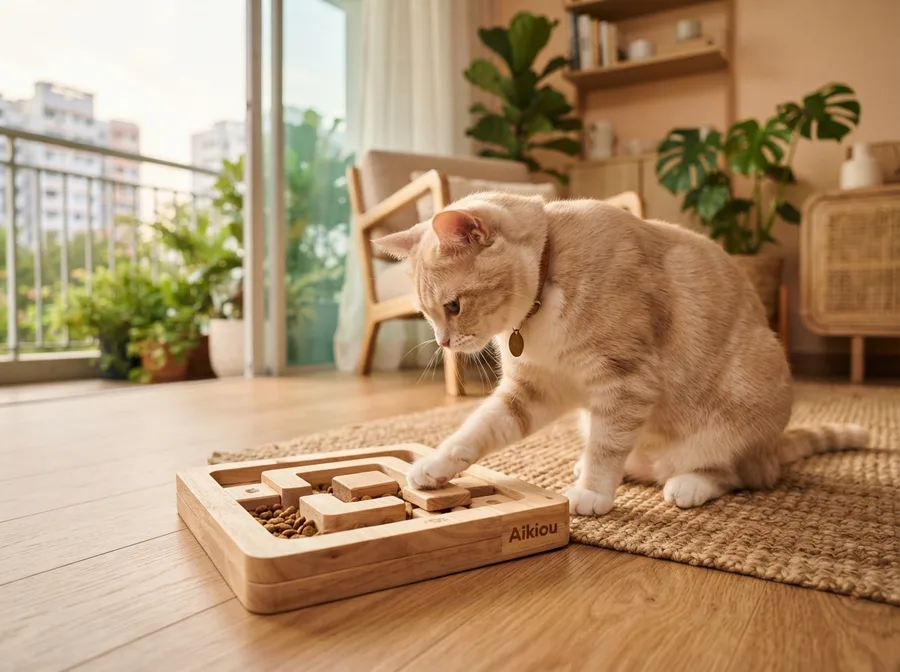
Feeding is the most underused enrichment tool in a small flat, because it happens anyway and costs nothing extra to restructure. In the wild a cat would work for ten or more small meals a day. In a flat it gets two large ones handed over free.
Start easy — a cat that fails at a puzzle simply walks away and waits for you to give in — then make it harder over weeks. And when you introduce puzzle feeding, do it in addition to the normal bowl at first, not instead of it, so nobody is skipping meals to make a point.
One caution specific to this climate: wet food does not sit out. Puzzle feeders that hold wet food need to be a supervised, short-session thing rather than a leave-it-out arrangement.
Checklist
- Puzzle feeders for dry food — start with the easiest setting and progress
- Scatter feeding — portion the kibble and hide it in five places around the flat
- Snuffle mats and rolled towels — cheap, washable, surprisingly effective
- Multiple small meals rather than two large ones, if your schedule allows
- A treat trail laid before you leave for work, so the empty flat starts interesting
- Water away from the food, ideally moving — hydration matters in this climate
- Never skip meals to force engagement — cats must not go without food for long
The nine hours you are not home
The working day is the hard part of indoor life in Singapore, and it is where most enrichment plans quietly fail.
A window with something happening
The single best passive enrichment there is. Behind mesh, with a perch. Free, all day, endlessly variable.
Rotation, not accumulation
Four or five toys out, the rest in a box, swapped weekly. Cats habituate to a static object within days; a rotated one reads as new.
Cardboard
A delivery box with two holes cut in it outperforms most things you can buy, and it is disposable when it gets grubby. Change the box, change the game.
Cat grass
Something legitimate to chew, which reduces the appeal of your houseplants. Grow it away from anything toxic.
Hiding places at floor level
A covered bed, a box on its side, space under a chair. Cats need somewhere to retreat to as much as somewhere to climb.
A considered second cat
A well-matched pair solves the working day better than any object. A badly matched one creates a tense flat. Two per HDB flat is the cap.
Scratching, and why the sofa keeps losing
Scratching is not damage. It is maintenance, marking and a full-body stretch — and it will happen somewhere.
The reason a cat chooses the sofa arm over a post is almost always one of three things: the post is too short to stretch fully against, it wobbles, or it is in the spare room while the sofa is in the middle of the action. Cats scratch where they socialise, not where it is tidy.
So put the post next to the sofa first and move it gradually if you must, rather than putting it where you would like it and hoping. And do not throw out a shredded post the moment it looks ugly — a well-used post is a scent-marked post, which is precisely why the cat likes it.
Key numbers
- Height
- Taller than a full stretch
- Stability
- It must not wobble at all
- Texture
- Sisal, cardboard, or bare wood
- Angle
- Offer vertical and horizontal
- Placement
- Where the cat already scratches
- Count
- More than one, in different rooms
- Replacement
- Every few months, when shredded
How this fits the rest of flat life
Enrichment is the other half of cat-proofing. A flat that is safe but featureless produces a cat that manufactures its own entertainment, usually out of something you own. A flat that is interesting but unmeshed is not a flat a cat should be in at all. Do both, in that order: proof the flat first, then build the territory.
It also shapes which cat suits your home. A household that is empty from 8am to 7pm can absolutely keep a cat well, but it should think harder about activity level, and it should think seriously about a bonded pair. A very active, very people-oriented cat in an empty flat is the combination that generates the most difficult behaviour. Breeds suited to HDB living is written with exactly this in mind, and the one-cat versus two-cat question covers the pair decision properly.
Finally, be honest about the failure signals. Over-grooming, sudden litter-tray avoidance, night vocalising and aggression can all be enrichment problems — and they can all be medical problems that look identical from the outside. If a behaviour changes suddenly, the vet comes before the cat tree.