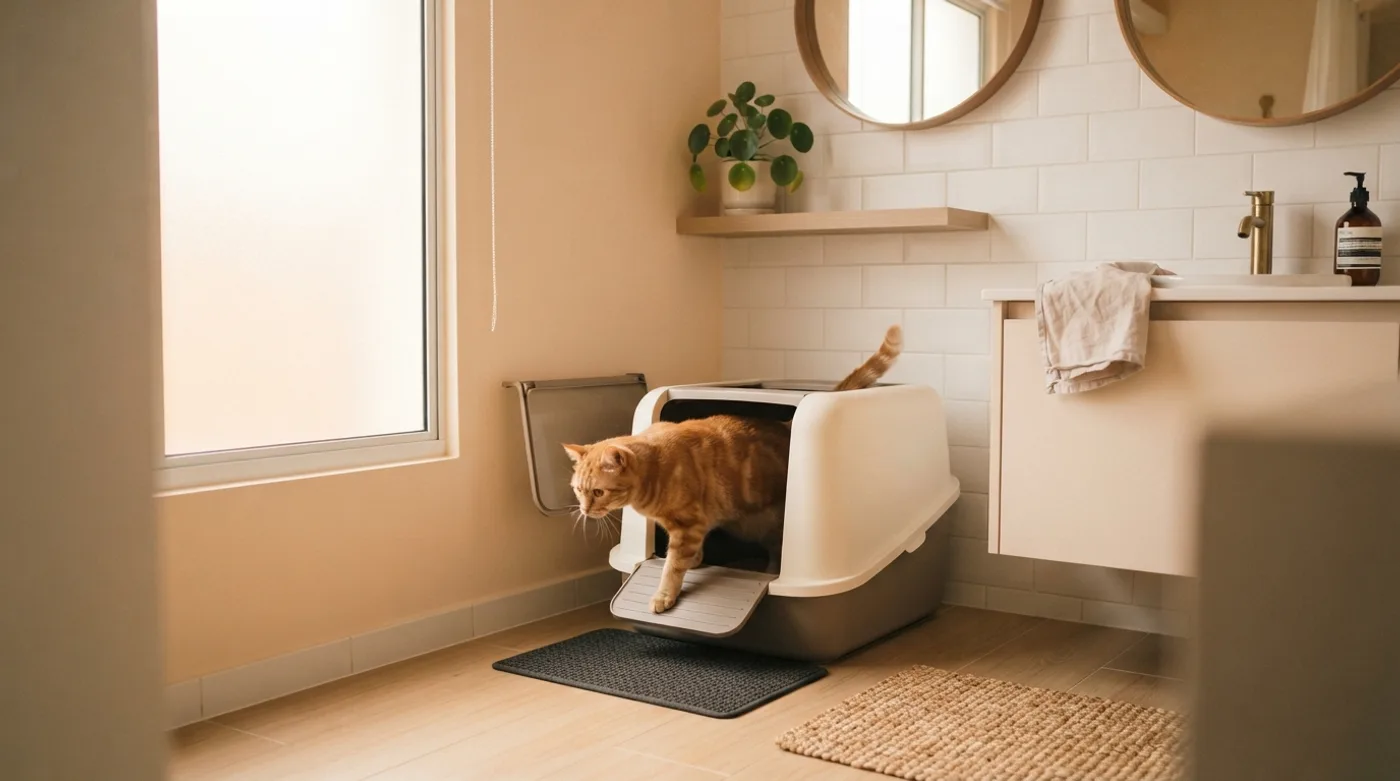
What you are actually choosing between
Litter shopping in Singapore looks like a wall of brands. It is really a choice between four materials, and each one trades the same six variables differently: odour control, dust, tracking, weight, cost and disposal.
In a flat, those trade-offs are not theoretical. The tray is a few metres from where you eat and sleep, the litter has to be carried home from a shop or up from a lift lobby, and the humidity makes everything smell more than it would in a cooler place.
There is also a seventh variable, and it overrides all six: whether your cat will use it. Cats have real preferences about what a toilet feels like underfoot — most prefer fine, soft, sand-like substrate, which is what they would have chosen in the wild — and a cat that dislikes the litter does not complain. It goes somewhere else, and then you have a much bigger problem than dust.
So the honest recommendation is procedural rather than prescriptive: pick the type that fits your household on the six variables, buy the smallest bag available, and treat the first fortnight as a trial rather than a commitment.
The cat gets a vote
A litter your cat avoids is not a cheaper litter. Tray avoidance takes weeks to unwind and often needs a vet visit to rule out a urinary cause first.
The four types, compared
What each material is good at, and what you pay for that.
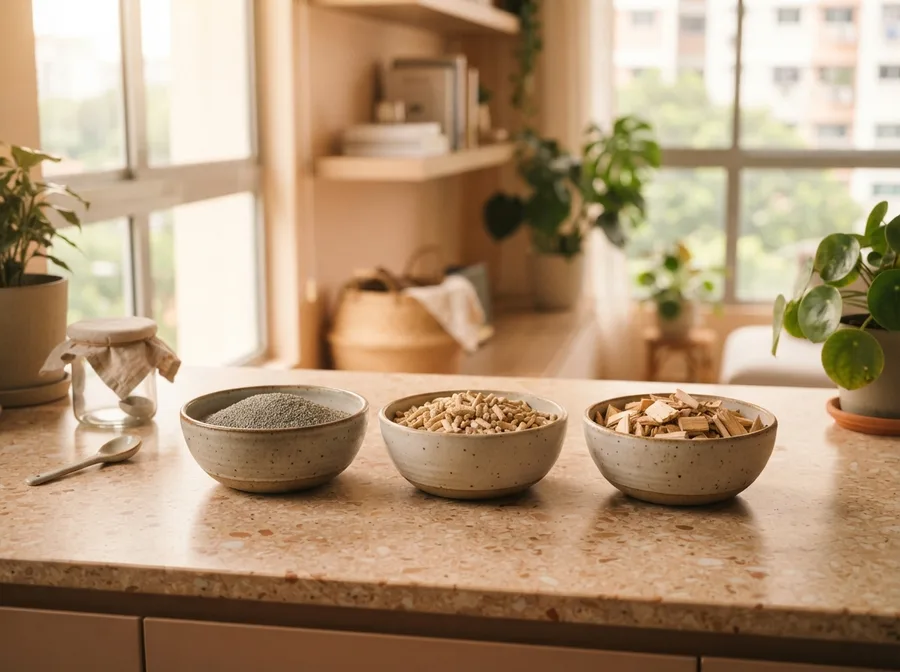
Clumping clay (bentonite)
The default for good reason: forms hard clumps, controls odour strongly, cheapest per use, and available everywhere. Most cats accept it readily because the fine grain feels like sand.
Clay — the trade-offs
Heavy to carry, dusty, and the fine granules track further than anything else. Bin disposal only. In a flat without a lift lobby drop-off, the weight alone puts people off.
Tofu litter
Made from soybean by-product. Light, very low dust, clumps well, and a strong all-rounder for flat living. The most popular alternative to clay in Singapore homes for exactly those reasons.
Tofu — the trade-offs
Costs more than clay, and it can soften or go off if stored badly in humidity. Some are described as flushable in small amounts — bin it anyway.
Silica crystal (gel)
Absorbs moisture and odour rather than clumping. You scoop solids and stir the rest, with a full change on a schedule. Very good odour control when the schedule is kept, and lasts longer between changes.
Wood pellets
Compressed sawdust that breaks down when wet, with a natural pine scent and low dust. Cheap and light. Needs a sifting tray, and the coarse texture is the one many cats reject outright.
Scored against a Singapore flat
Rough ordering on the variables that decide it in practice.
No column wins outright, which is the point. A household that carries litter home on the MRT weights the weight column heavily; a household with an asthmatic member weights dust; a household with a shy cat weights acceptance above everything.
Note the last row. Regardless of what the packaging says, the safe default in Singapore is to bag waste and bin it. Shared plumbing stacks and older pipework make flushing a poor gamble with very little upside.
Key numbers
- Best odour control
- Clay and silica
- Lowest dust
- Tofu and wood
- Least tracking
- Wood, then tofu
- Lightest to carry
- Tofu and wood
- Cheapest per use
- Clay
- Most cats accept
- Fine clay, then tofu
- Disposal
- Bag and bin — all four
Odour control that actually works
In this order. The first two do most of the work.
- 1Scoop twice a dayMorning and evening, without exception. This single habit outperforms every product decision on this page, and the heat here makes it matter more than it would elsewhere.
- 2Keep the depth rightAround 5cm. Too shallow and urine reaches the base, where it sets into a smell no amount of scooping removes.
- 3Full change on a fixed scheduleEmpty, wash with unscented soap and warm water, dry completely, refill. Not bleach, and never a phenolic disinfectant.
- 4Bag it properlyA sealed bag into the chute, not a bin left by the front door. Corridor smell is the single most common source of neighbour complaints about cats.
- 5Place the tray for airflowVentilated but low-traffic, away from food and water, and never somewhere a closed door can cut the cat off from it.
- 6Replace the tray itselfScratched plastic holds odour permanently. A tray that smells after a full change is a tray at the end of its life.
What does not work: perfumed litter, deodorising sprays and scented liners. They add a smell on top of a smell, and many cats find heavily fragranced litter aversive enough to stop using the tray. Unscented plus frequent scooping beats fragrance every time.
Switching without a protest
An abrupt litter change is one of the more common triggers for a cat suddenly going outside the tray, and it is entirely avoidable. Cats build a strong association with a specific texture underfoot, and replacing that overnight is a bigger event than it looks from the outside.
The method is the same as switching food. Mix a small proportion of the new litter into the old, then increase it every few days over a week or two. If the cat hesitates at any ratio, hold there for longer rather than pressing on.
When a new kitten arrives, do not switch at all for the first fortnight. Use the same litter the breeder or shelter used — a kitten changing homes is already dealing with a new flat, new people and new food, and the toilet is not the thing to also make unfamiliar. Setting up the tray for a new kitten covers the rest of that first fortnight.
If a cat starts avoiding the tray after any change, work the variables in order: rule out a urinary problem with a vet first, then look at cleanliness, location, tray size, and finally the litter itself. A cat straining or producing little urine needs a same-day appointment — that is an emergency in male cats, not a preference.
Trays, mats and the small-flat setup
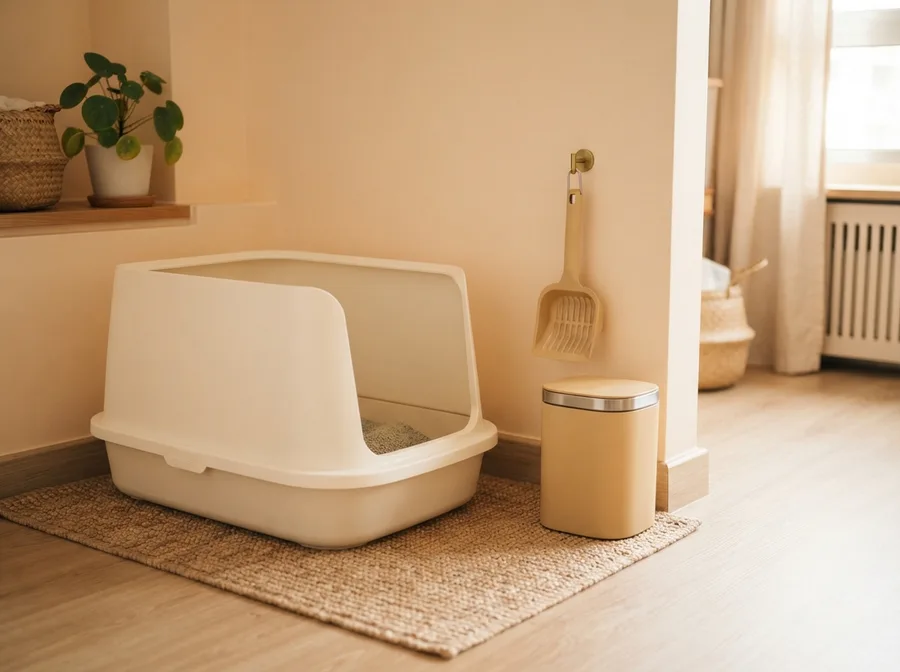
The hardware around the litter matters as much as the litter.
A well-chosen litter in a badly chosen tray, in a badly chosen spot, still produces problems. Most tray hardware sold in pet shops is sized for kittens and marketing photographs rather than for adult cats.
Covered trays and litter cabinets are the classic small-flat compromise. They genuinely reduce scatter and visible mess, and they concentrate odour inside the box — which is fine for you and less fine for the cat sticking its head in there. If you use one, scoop more often, not less, and always give a nervous cat an open alternative somewhere else.
Checklist
- Tray about 1.5× the cat's length, nose to base of tail — most are too small
- Low sides for kittens and older or arthritic cats; higher sides for enthusiastic diggers
- A large mat outside the tray, ideally one with a textured top and a smooth underside
- Quiet, always-accessible location — never behind a door that gets closed
- Never beside food or water, and never next to the washing machine
- Two trays if space allows, in different rooms, for one cat
- Scoop, bags and a lidded bin kept next to the tray so the routine is frictionless
What it costs over a year
Litter is a permanent monthly line rather than a one-off, and the type you pick sets that line for years. Clay is generally the cheapest per use; tofu and silica cost more but can last longer between full changes, which narrows the gap more than the shelf price suggests.
The more useful way to think about it is per-month, multiplied by fifteen years, alongside food — because together those two are the largest recurring cost in cat ownership by a wide margin. Our breakdown of what a cat actually costs here puts litter in context against setup, vet care and the emergency layer.
One economy that is not an economy: buying the largest sack of a litter your cat has not yet approved. Small bag first, then bulk. And in this humidity, store what you buy sealed and off the floor — tofu litter in particular degrades if it takes on moisture before it reaches the tray.
For the other half of the daily routine, how to choose and store cat food here covers the same ground on the food side, including why hydration matters so much in this climate.
Watch what you scoop
Daily scooping is also daily monitoring. Straining, blood, a sharp change in urine volume or persistent diarrhoea are all reasons to call a licensed Singapore vet.
Clay, crystal and tofu: cost per month, and how to switch
Litter is the one recurring cost you choose every month, and the differences between the types are about your flat as much as about the cat.
| What it does well | What it costs you | |
|---|---|---|
| Clumping clay litter | Best odour control and the easiest daily scoop — waste comes out as a solid clump | Heaviest to carry up, dustiest, and the highest volume of waste per month |
| Crystal (silica) litter | Absorbs moisture and holds odour for longer between full changes; very low dust | Solid waste still needs removing daily, and some cats dislike the texture underfoot |
| Tofu / plant litter | Light to carry, low dust, clumps well, and flushable in small amounts | Shorter working life in humidity, so the cost per month is usually the highest |
| Paper / recycled pellet | Kindest on a post-operative or very young kitten’s paws | Weakest odour control — realistically a temporary choice |
Work out cost per month rather than price per bag, because the bags are not comparable. What actually drives the monthly figure is how much you have to discard at each full change and how often the type forces one — which is why a cheap clay bag and an expensive tofu bag can land within a few dollars of each other, and why Singapore’s humidity pushes the plant litters up rather than down.
Switching litter is where owners create the problem they were trying to avoid. Do not swap types in one go: a cat that finds an unfamiliar substrate in its tray may simply choose your bathmat instead, and once that has happened twice it is a habit. Mix the new litter into the old at roughly a quarter, then half, then three quarters over a week or two, and keep the tray in exactly the same place while you do it.
A multi-cat flat changes the arithmetic twice over. The rule of thumb is one tray per cat plus one, so two cats means three trays, which means three times the volume and three scoops a day rather than one. It also means you cannot quietly under-clean: cats are considerably fussier about a shared tray than a private one, and the first sign you have got it wrong is one cat waiting for the other to finish and then not bothering.