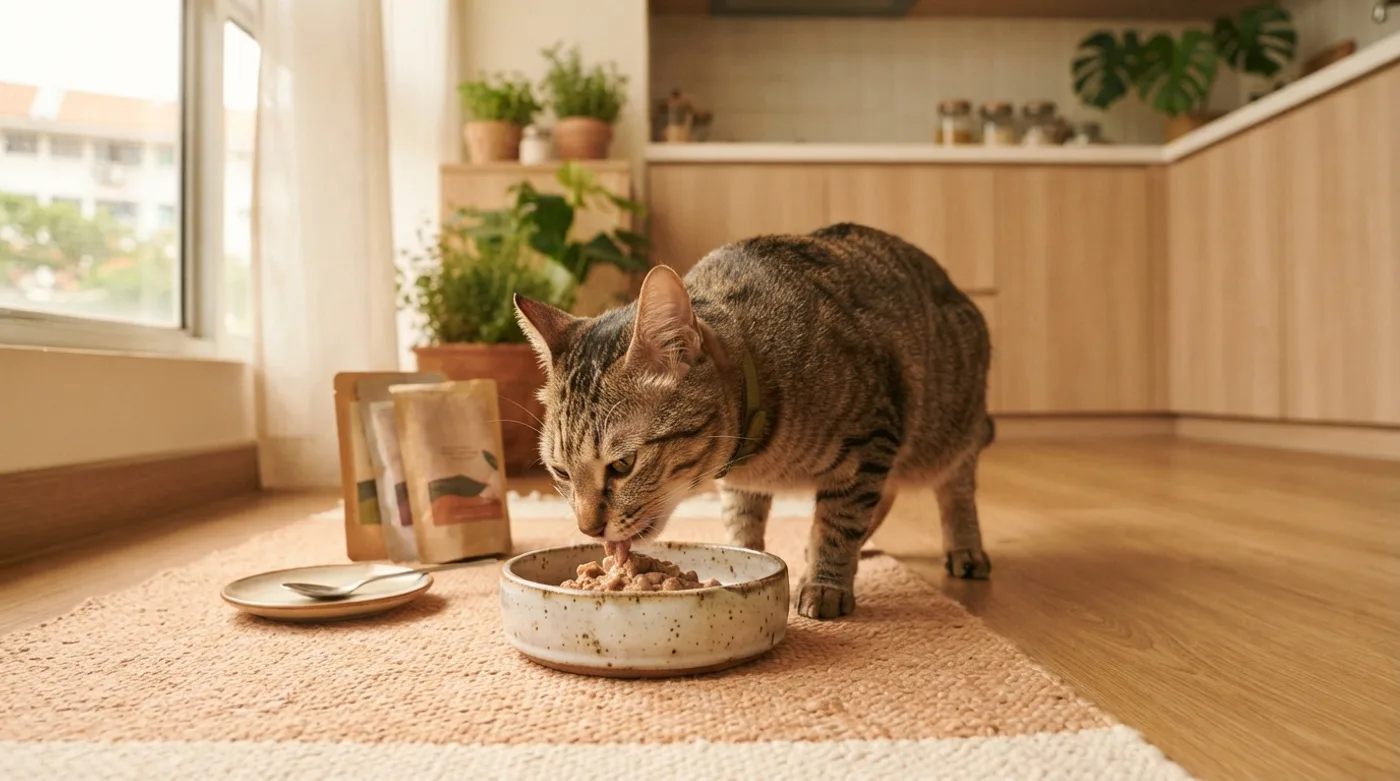
What "best" actually means here
Cat food marketing is built to make this question feel complicated, and it mostly is not. Almost every food sold in Singapore pet shops is complete and balanced. The differences that matter are narrower and less glamorous than the packaging suggests.
A genuinely good diet for a Singapore cat does four things: it is complete and balanced for the right life stage, it delivers enough water, the cat actually eats it, and you can buy it reliably for the next decade without hunting through three websites.
That last criterion is underrated. The best food in the world is a bad choice if it is a grey import that disappears for two months, because the alternative to consistency is an abrupt switch — and abrupt switches produce diarrhoea, which produces litter-tray avoidance, which produces a much worse week than choosing a boring reliable brand would have.
What we will not do on this page is name brands. Availability, formulation and pricing all change, and a brand recommendation written today is misinformation in eighteen months. What does not change is how to read a label and what to watch for in the cat.
The one non-negotiable
Cats are obligate carnivores. They require taurine, preformed vitamin A and arachidonic acid from animal tissue. There is no safe plant-based diet for a cat.
Wet, dry and raw, honestly compared
Each format has a genuine case. Most Singapore households end up combining the first two.
Wet food — hydration
Typically around three-quarters water, which does most of the work in a species with a weak thirst drive. Best single argument for it, and the reason vets push it for cats with urinary history.
Wet food — the costs
More expensive per calorie, heavier to carry home, and it cannot sit out in this climate. Twenty minutes at room temperature in an unairconditioned flat is about the limit.
Dry food — convenience
Storable, cheaper per calorie, and the only format that works in puzzle feeders and scatter feeding. Genuinely useful for the working day.
Dry food — the catch
Contributes almost no water, and free-feeding a bowl of it all day is the most common route to a chubby indoor cat. Measure it; do not top it up.
Raw — the case
Some cats do visibly well on a properly formulated raw diet, and owners often report better coats and smaller stools.
Raw — the risks
Bacterial contamination for cat and household, and nutritional imbalance from unformulated recipes. Heat and humidity here shrink the handling margin. Vet input, not a blog recipe.
Reading a label in ninety seconds
Ignore the front of the pack entirely. Everything useful is on the back.
- 1Find the nutritional adequacy statementWording along the lines of "formulated to meet the nutritional levels established by the AAFCO cat food nutrient profiles" — or the FEDIAF equivalent — plus the life stage. No statement, no purchase.
- 2Check the life stage matchesGrowth, adult maintenance, or all life stages. A kitten needs growth or all-life-stages, not adult maintenance.
- 3Read the first few ingredientsNamed animal proteins — chicken, salmon, turkey — rather than unspecified "meat derivatives". Ingredients are listed by weight before cooking, so a named meat first is a reasonable signal, not a guarantee.
- 4Glance at the guaranteed analysisProtein, fat, fibre, moisture. It is more useful for comparing two dry foods than for comparing wet against dry, because moisture content makes the percentages incomparable.
- 5Note the feeding guideYour starting point for portioning. Then adjust based on the cat, not the chart.
- 6Check the date and the sealEspecially relevant here — a bag that has spent a long humid transit is a different product from a fresh one.
Marketing terms worth discounting: "premium", "holistic", "human-grade" and "ancestral" have no regulatory meaning. "Grain-free" is a positioning choice rather than a health claim for most cats — grains are not a common feline allergen, and the meaningful question is whether the food is complete, not whether it contains rice.
Hydration: the Singapore-specific part
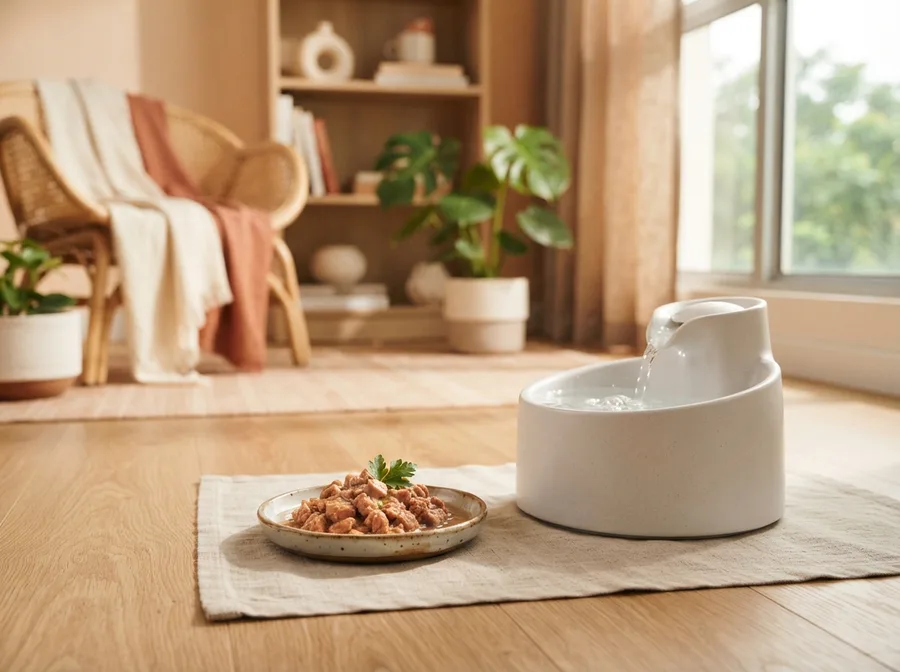
If there is one thing to take from this page, it is this. Cats descend from desert animals and have a famously poor thirst drive — they do not reliably drink to correct a deficit the way a dog will. In the wild that is fine, because prey is roughly three-quarters water. On a dry-food-only diet in an air-conditioned flat, it is a slow, chronic problem.
The consequences are not abstract. Concentrated urine is a contributing factor in the urinary tract disease that sends a lot of Singapore cats to the vet, and male cats in particular can progress to a blockage, which is a same-day emergency and an expensive one. Chronic kidney disease in older cats is another reason vets push water intake early rather than late.
The intervention is simple: get more water into the food. Feed wet food at meals, or add a splash of warm water to wet food, or if the cat is committed to dry, soak a portion of it. Cats vary in what they will tolerate, so experiment while the cat is young and flexible rather than after a diagnosis.
Then make drinking easy. Water bowls go away from the food, in more than one room, wide and shallow so whiskers do not touch the sides. Many cats prefer moving water and will drink noticeably more from a fountain — in this climate, keep it scrupulously clean and change the water daily, because a warm stagnant fountain is its own problem.

Feeding by life stage
The same cat needs materially different food at different points.
Two of these deserve emphasis. Sterilisation lowers a cat's energy requirement fairly promptly, and the weight gain that follows is not caused by the surgery — it is caused by continuing to feed the same amount afterwards. Adjust portions in the weeks following; our sterilisation guide covers the rest of the aftercare.
Weight loss in cats must be slow. A cat put on a crash diet can develop hepatic lipidosis, a serious liver condition — this is genuinely dangerous, and any weight-loss plan belongs with a vet rather than with a bathroom scale and good intentions.
Key numbers
- Kitten to ~12 months
- Growth formula, small frequent meals
- Adult 1–7 years
- Maintenance, portion-controlled
- Senior 7+ years
- Watch weight, kidneys, teeth
- After sterilisation
- Energy needs drop — reduce portions
- Overweight cat
- Slow loss only, under vet guidance
- Urinary history
- Wet-led diet, often prescription
Buying, storing and the humidity problem
Storage matters more here than in the countries most feeding advice is written for.
A large sack of kibble is cheaper per kilo and worse in this climate. Fats oxidise, palatability drops, and a bag opened in an unairconditioned kitchen for eight weeks is not the food it was on day one. Cats notice before we do — a cat that suddenly goes off a food it has eaten for a year is quite often reacting to a stale bag rather than being difficult.
The same reasoning applies to buying itself. A slightly more expensive brand you can reliably buy from a shop you pass anyway beats a bargain that requires a bulk order every quarter.
Checklist
- Buy bag sizes you finish in about a month, not the biggest sack on offer
- Keep the food in its original bag, inside the airtight container — the bag is a moisture barrier
- Store in the coolest, driest cupboard, never on the floor beside the service yard
- Wet food goes in the fridge once opened, and is served closer to room temperature
- Discard uneaten wet food within about twenty minutes in an unairconditioned flat
- Wash bowls daily — a greasy film goes rancid quickly in this heat
- Keep a spare week of food, so a stock-out never forces an abrupt switch
Switching food without a bad week
Almost every food-related problem people ask about is really a transition problem. Cats have a genuine neophobia around food — a preference for what is familiar that is stronger than in most species — and their digestive systems adapt slowly to a new formulation.
The reliable method is boring: a quarter new food for two days, half for two days, three quarters for two days, then all new. If stools loosen at any stage, hold at that ratio for a few extra days instead of pushing forward. Ten days of patience costs nothing; two weeks of diarrhoea in a kitten is a vet visit and a litter-training setback.
A fussy cat is usually a routine problem rather than a taste problem. Feed at consistent times, take the bowl away after twenty minutes rather than leaving a buffet, and stop offering alternatives every time the cat hesitates — a cat that has learned that refusing produces something better will keep refusing. The exception is important: a cat that genuinely stops eating for more than a day needs a vet, not more patience. Prolonged inappetence in cats is dangerous.
And when a kitten first comes home, do not change the food at all. Keep the breeder's food for the first two weeks and transition afterwards — the first days at home covers the rest of that fortnight, and the running-cost picture shows where food sits against everything else.
Not eating is an emergency sooner than you think
A cat that has eaten nothing for over 24 hours needs a licensed Singapore vet. Cats do not tolerate fasting the way dogs do, and the liver complications develop quickly.