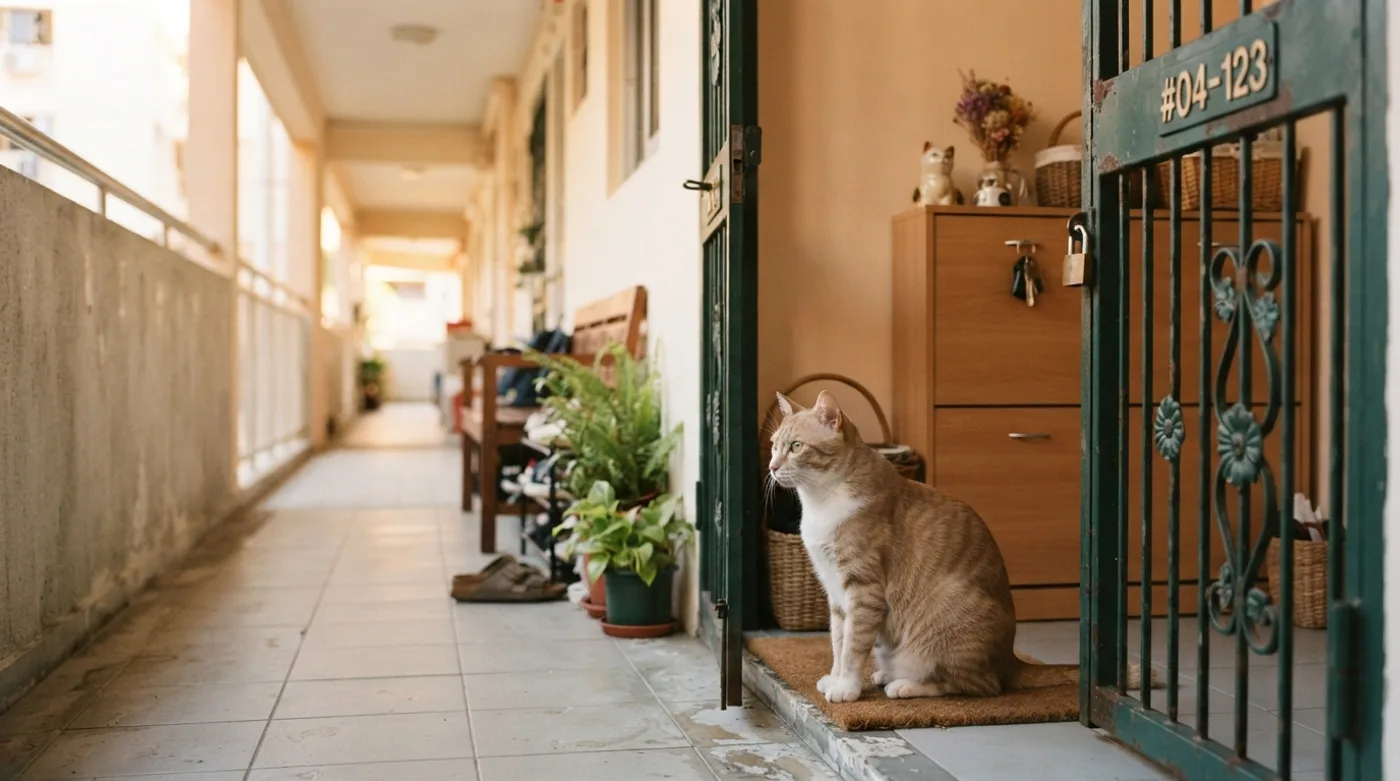
What actually changed in September 2024
For most of Singapore's public-housing history, cats were not permitted in HDB flats. The rule was widely ignored — a large number of flats quietly kept cats for years — but it was still the rule, and it left owners in an awkward position: no licence, no formal recognition, and a neighbour complaint away from a problem.
The Cat Management Framework ended that. The Pet Cat Licensing Scheme opened on 1 September 2024, and for the first time HDB residents can legally keep cats provided each one is microchipped and licensed and the household meets responsible-ownership conditions.
It is worth being precise about what the change is and is not. It is not a relaxation of pet rules in general, and it is not a blanket permission — it is a licensing regime. Cats became legal and regulated in the same stroke, which is why the paperwork side of cat ownership in Singapore is now closer to dog ownership than it has ever been.
Both primary sources are worth reading once yourself rather than relying on word of mouth: the AVS Cat Management Framework page and HDB's announcement of the scheme.
The one date that matters
Licensing is free until 31 August 2026. After that a fee schedule applies. Nothing about the process gets easier by waiting, and it gets more expensive.
The rules in six lines
This is the whole framework as it affects an ordinary flat, before any of the nuance.
Everything else — mesh, sterilisation, keeping the cat indoors, keeping the corridor clean — sits under the heading of responsible ownership rather than a numbered rule. That does not make it optional in practice. It makes it the part nobody checks until there is a complaint.
The full application walkthrough, including the one-time Pet Ownership Course, is in our cat licensing guide.
Key numbers
- Cats in HDB
- Allowed since 1 Sep 2024
- Cap per flat
- Two cats
- Microchip
- Required for every cat
- Licence
- Required, applied via PALS
- Cost now
- Free until 31 Aug 2026
- From 1 Sep 2026
- S$15/yr sterilised · S$90/yr not
Two cats per flat, and what that really means
The cap is two cats per HDB flat, and the wording matters more than people expect. It is a per-flat limit, not a per-person one. A three-bedroom flat shared by three tenants is still a two-cat flat.
It also applies to the cats living there, not the cats you own on paper. Fostering, cat-sitting for a travelling friend, or "temporarily" taking in a third cat all count against the same number while those animals are in the flat.
Private residential property is allowed a higher number, which occasionally causes confusion when advice written for a condo circulates in an HDB group chat. If you are reading a rule about cats in Singapore and it does not say which housing type it applies to, assume it does not apply to you.
The practical consequence for most households is a decision made early rather than late: one cat or two. Two is genuinely easier on the cats — a bonded pair entertains itself through a nine-hour working day in a way a solo cat cannot — but it doubles food, litter, vaccination, sterilisation and, from September 2026, licence fees. We work through that trade-off in how many cats you can keep in an HDB flat.
Microchip and licence: the sequence
Four steps, in this order. The order is not negotiable — the licence is issued against the chip number.
- 1Microchip the catA vet implants the chip; it takes seconds. A kitten from a licensed breeder usually arrives already chipped — ask for the number and watch it scan before you take the kitten home.
- 2Put the registration in your nameA chip is a number, not a database entry. If the registered contact is still the breeder, or an old phone number, the chip does nothing on the day it matters. This is the single most-skipped step in the whole process.
- 3Complete the Pet Ownership CourseFree, online, one-time, and only for first-time applicants. It covers the basics of responsible care and takes an evening at most.
- 4Apply through PALSSubmit at pals.avs.gov.sg with the microchip number and your details. Free until 31 August 2026.
If you already had a cat before September 2024, this is the same four-step sequence — the transition period was designed for exactly your situation, and the whole thing currently costs nothing.
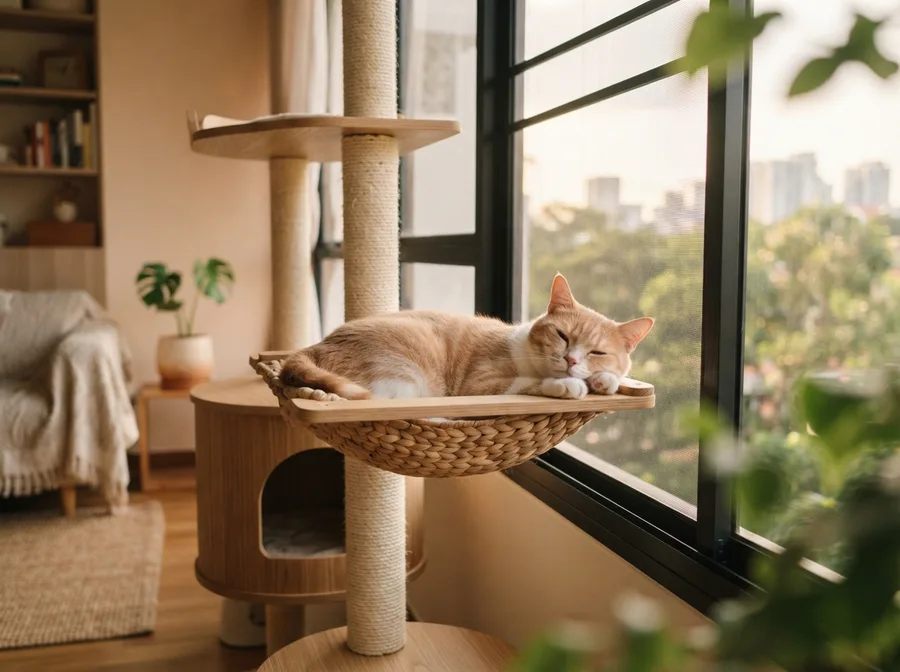
Responsible ownership, translated into a flat
The framework's expectations, expressed as things you actually do to a home.
The framework talks about responsible ownership in general terms. In a twelfth-storey flat, those terms have a very specific meaning, and the top of the list is not negotiable.
Falls are the risk that defines cat ownership in Singapore. The mechanism is rarely a cat deciding to jump; it is a bird, a moth, a sudden noise, a mistimed leap onto a narrow ledge. Full mesh across every openable window and any balcony opening removes almost all of it, and it needs to be in place before a cat is in the flat rather than after the first scare.
The rest is about keeping cat ownership invisible to your neighbours — because the complaints that reach a town council are almost always about smell, noise or a cat in the corridor, not about the cat existing.
Checklist
- Mesh every openable window and the balcony — the single most important thing on this page
- Keep the cat indoors, which also means the gate and the front door, not just the windows
- Sterilise — less spraying, less yowling, no unplanned litters, and a lower licence fee later
- Scoop daily — corridor smell is the most common source of neighbour complaints
- Litter and food waste in sealed bags, into the chute, never left outside the door
- Scratching posts and vertical space, so the cat is not solving boredom on your furniture
- Keep the licence and chip details current when you move flat or change your number
The situations the rules do not cover cleanly
Where the framework and real life do not line up, and what to do about it.
You rent
HDB permits cats; your tenancy agreement may not. The pet clause in your lease still governs, and a landlord is entitled to say no. Get it in writing before you commit to a kitten, not after.
You are moving flat
The licence and the microchip registration both carry an address. Update them when you move. An escaped cat found three streets away is only returned if the record points somewhere current.
You already have two cats
Then the answer to a third is no, however good the reason. This is one of the few genuinely hard numbers in the framework.
You feed community cats
Feeding is not owning, and community cats are managed under separate arrangements built around sterilisation rather than individual licensing. Take one in as a pet, though, and the usual rules apply.
You are fostering
A fostered cat lives in the flat and counts while it is there. Foster with a group that understands the cap and will not place you over it.
A neighbour complains
A licensed, sterilised, indoor cat with a clean corridor is a very short conversation. An unlicensed one is a longer one. This is the practical argument for doing the paperwork.
Choosing a cat that suits a flat
Once the rules are settled, the decision that actually shapes the next fifteen years is which cat. Almost every Singapore cat lives entirely indoors, so temperament and activity level matter more here than they would in a house with a garden and a cat flap.
Broadly: calm, people-oriented, adaptable cats settle into flat living with very little friction. Highly active, highly vocal or intensely people-dependent cats can do well too, but only in a household that supplies real enrichment and is not empty for eleven hours a day. Neither category is better; they are different amounts of work.
If you are still deciding, the breeds best suited to HDB flats gives a straight verdict breed by breed, and adopting from a Singapore shelter is worth weighing seriously — an adult cat arrives with a known temperament, which is a real advantage when you are choosing for a specific home.
Corridors, carriers and what counts as a nuisance
The framework is the statutory part. Living with neighbours is the part that actually generates complaints.
Take the statutory side first, because it is short. The Cat Management Framework makes cats permitted in HDB flats subject to licensing and microchipping, and from 1 September 2026 it becomes an offence to keep an unlicensed pet cat. AVS sets the penalty schedule, and it is AVS’s to state rather than ours to paraphrase — the point for an owner is that the licence is free until 31 August 2026, so there is no version of this where waiting helps. One thing people expect and will not find: there is no approved breed list for cats. The dog schedules have no cat equivalent under this framework.
Then the neighbour side, which is where enforcement interest usually comes from. A cat in the common areas — the corridor, the lift lobby, the stairwell — is the single most common complaint, and it is also the most dangerous thing for the cat: a corridor is one open lift door away from the ground floor. Keep the cat inside the flat. If you need to move it through common areas, use a carrier rather than carrying it loose, and if you use a harness treat it as a backup for a carrier rather than a substitute, because a startled cat comes out of a harness faster than you can react.
Nuisance, in practice, means three things: smell reaching the corridor or the flat next door, noise from an unsterilised cat calling at night, and a cat that gets out and turns up on someone else’s doormat. All three have unglamorous fixes. Site the litter tray away from your own front door and scoop daily. Sterilise, which removes the calling and lowers your licence fee once fees begin. And treat the main door as an airlock, especially at delivery time.
If you rent, none of the above overrides your tenancy agreement. The framework made cats legal in HDB flats; it did not rewrite the clause you signed. Get written landlord permission before you commit to a cat, and get it before any deposit changes hands.
Checklist
- Unlicensed pet cat becomes an offence from 1 September 2026 — confirm the penalty schedule with AVS
- No approved breed list applies to cats
- Cat stays inside the flat; common areas are not enrichment
- Carrier for any trip through corridors or lifts — harness as a backup, never instead
- Litter tray away from the front door, scooped daily
- Sterilise: it removes night calling and cuts the future licence fee
- Renting? Written landlord permission before any deposit