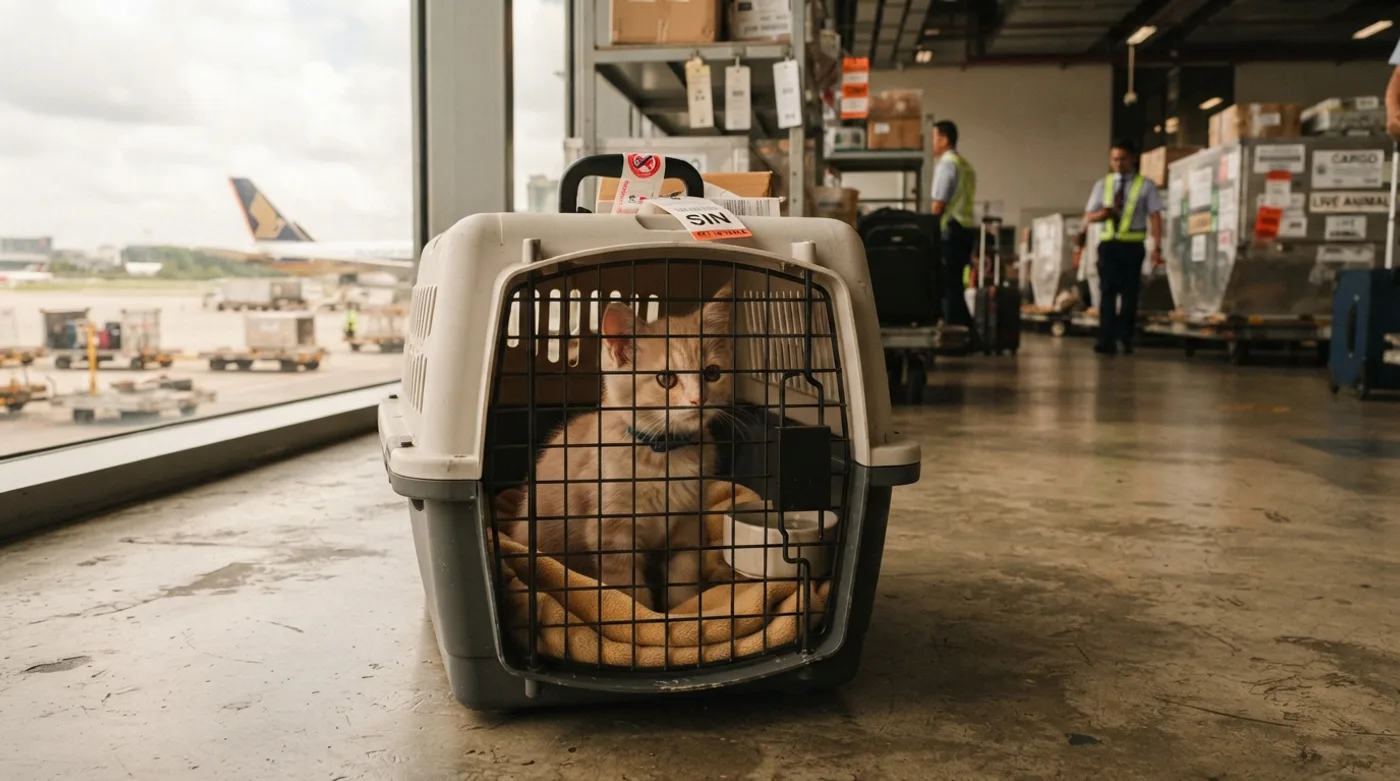
What importing actually is
Bringing a cat into Singapore is a biosecurity process that happens to involve a cat. It falls under the Animal & Veterinary Service, a cluster of NParks, and approval has to exist before the animal travels — not on arrival, and not retrospectively.
The shape of it is consistent even though the details vary by origin. There is a licence and a permit to obtain. There is a microchip, so the animal on the health certificate is provably the animal in the crate. There is a vaccination record. There is veterinary certification from the exporting country, issued inside a defined window before departure. And there are conditions — testing, waiting periods, and in some cases quarantine — set by the risk category of the country the cat is leaving.
What makes it hard is not any single requirement. It is that the requirements are sequenced and time-boxed. A test done too early expires. A vaccination done too late does not count. A certificate signed by the wrong category of vet is not accepted. Getting one step out of order can reset a chunk of the timeline, and the kitten is growing up in someone else's cattery while you fix it.
Because these conditions change and differ by country, treat everything on this page as orientation. The definitive source is AVS, and the right first move is to ask them what applies to your specific exporting country before any money changes hands.
Start with AVS, not with the breeder
The most expensive version of this process is the one where a kitten is reserved and paid for, and the import conditions are read afterwards. Establish the requirements for that country first.
The cost stack nobody quotes you
The kitten price is the line item people plan for. It is rarely the largest one.
Every one of these is real, and several are non-optional. Quotes from pet relocation agents vary enormously by route, season and whether the cat travels as manifest cargo or in the cabin of a permitted carrier — which is why we do not publish a figure here that would be wrong for most readers.
What is safe to say is directional: for a mainstream pedigree breed, the total landed cost of an imported kitten is usually a multiple of what an equivalent kitten costs from a licensed Singapore cattery. Our guide to kitten prices here gives the local ranges to compare against.
Key numbers
- The kitten
- Overseas cattery price
- Permit and licence
- AVS fees, before travel
- Export vet work
- Tests, certificates, timings
- Crate
- IATA-compliant, sized to the cat
- Airfreight
- Usually the biggest single line
- Agent
- Handling both ends
- Quarantine
- If the origin requires it
The timeline, and why it runs in months
The order matters more than the individual steps. Each one gates the next.
- 1Confirm the conditions for that countryAsk AVS what applies to the specific exporting country. This determines testing, waiting periods and whether quarantine is in play — and therefore the entire budget and calendar.
- 2Reserve the kitten, conditionallyA breeder who has exported before will understand a conditional reservation. One who wants full payment before the import route is confirmed is telling you something.
- 3Microchip and vaccinate to the required scheduleThe chip has to be in place first so every later document refers to an identifiable animal. Vaccinations then have to fall inside the accepted windows.
- 4Complete the required testingWhere blood testing applies, there is usually a waiting period afterwards before the cat may travel. This is the step that turns weeks into months, and it cannot be compressed.
- 5Apply for the import licence and permitIssued before travel, valid for a defined period. Book flights around the permit, not the other way round.
- 6Health certification and departureAn official veterinary certificate from the exporting country, signed within the accepted window, plus an IATA-compliant crate the cat has had time to get used to.
- 7Arrival, clearance and any quarantineInspection on arrival, and — depending on origin — a period at the government facility before the cat comes home.
- 8Then license it locallyImport clearance is not a licence. Register the microchip to you and apply through PALS, free until 31 August 2026.

What the journey costs the cat
The financial cost is the part buyers research. The welfare cost is the part that decides whether importing is the right call for a particular animal.
A long-haul flight is a genuinely hard experience for a cat: hours in a crate, unfamiliar noise and pressure changes, handling by strangers at both ends, and — for some origins — a further period in quarantine before arriving in a home that is also completely new. Cats are territorial animals whose primary coping mechanism is retreating to somewhere familiar, and this process removes every familiar thing at once.
Most cats handle it. Some take weeks to decompress afterwards, hiding and eating poorly in the first stretch. It is worth planning the first month at home around that possibility: one quiet room, minimal visitors, and no expectation that the cat you meet in week one is the cat you will have in month three.
The mitigations are unglamorous and they work. Crate-train well ahead of travel so the box is a known space rather than a trap. Choose the shortest sensible routing rather than the cheapest multi-stop one. Use an agent who moves animals regularly on that route. And get a Singapore vet to look the cat over shortly after arrival, not weeks later.
When importing genuinely makes sense
There are real reasons. "It looked cheaper online" is not one of them.
A bloodline that is not here
Breeding programmes are the honest case. If you need specific lines for a registered programme, importing may be the only route.
A rare breed or variety
Some breeds have no Singapore presence at all, and a colour or coat variety can be genuinely unavailable locally in any given year.
You are relocating with your cat
A different situation entirely, and the most sympathetic one — the same AVS process, but you are moving an existing family member rather than acquiring one.
Health testing you can verify
Some overseas catteries publish screening results to a standard that is hard to match locally. Worth something — but check whether a local breeder can meet it before assuming.
Not for price
A low overseas sticker price plus import costs almost always exceeds the local price for the same breed. If the maths looks otherwise, re-check the maths.
Not for speed
Importing is the slowest way to get a cat. If the timeline matters, the local route is measured in weeks and this one in months.
The local alternative, honestly compared
What you give up by importing, and what you gain by not.
For most families the practical route is a licensed Singapore cattery. The kitten is already here, the seller is legally permitted to sell — only AVS-licensed sellers may sell pets in Singapore — and you can visit, meet the mother, see the environment the kitten was raised in, and ask questions of a person who is physically present.
That last point is not sentimental. Nearly every reliable signal about a kitten's future health and temperament comes from things you can only assess in person: how the mother behaves around strangers, how clean the setup is, whether the kittens have been handled, and whether the breeder asks you anything. None of that survives translation into a video call and a shipping quote.
If you do decide to import, the assessment framework is the same one you would use locally — it is just harder to apply at a distance. Our guide on how to vet a breeder covers the red and green flags in full.
Checklist
- You can meet the kitten before deciding, more than once if you want
- You can meet the mother — the single best predictor of adult temperament
- No flight, no quarantine, and no month-long decompression
- Records handed over in person — microchip number, vaccination card, health check
- Recourse if something is wrong, with a seller in the same jurisdiction
- Weeks, not months, and a total cost you can actually predict
- The same licensing step either way — chip, register, apply on PALS
After arrival: the part people forget
Clearing customs is not the finish line. An imported cat living in a Singapore flat is subject to exactly the same domestic rules as a locally bought one, and the two systems do not talk to each other.
That means: the microchip registration needs to be transferred into your name with your Singapore address and phone number, the licence has to be applied for through PALS, and the two-cat-per-flat cap applies to the household regardless of where the cats came from. The licensing walkthrough covers the sequence, and the HDB rules for cat owners covers the rest.
It also means a vet visit early rather than eventually. An imported kitten arrives with a health certificate written for a border, not a relationship with a clinic that will know the cat for fifteen years. Book that first appointment for the week after arrival — what happens at a first vet visit covers what to bring and what to ask.
We do not handle imports
Kitten.sg matches buyers with kittens from licensed Singapore breeders and catteries. Confirm every import requirement directly with AVS, and your cat's health with a licensed Singapore vet.
The AVS import process, checkpoint by checkpoint
Verified from AVS on 27 July 2026. Conditions change and they differ by where the cat is coming from, so treat this as the shape of the process and confirm every figure against the AVS page before you book anything.
- 1An import licence, applied for before travelBringing a cat in requires an AVS import licence. One difference from dogs is worth noting: a dog must have its dog licence before the import licence is applied for, whereas a cat does not need its cat licence first — the cat licence comes later, once the cat is here, and is required by the time it reaches three months of age.
- 2An ISO-compliant microchipThe chip is the identity the whole file hangs on, and it needs to be readable to the ISO standard AVS works to. Have it scanned and the number recorded before any of the veterinary paperwork is drawn up, because a number that does not match the documents stops the import.
- 3Rabies vaccination, then the titre testThe cat needs a valid rabies vaccination using a vaccine AVS accepts. Blood sampling for rabies serology — the rabies neutralising antibody titre test, RNATT — must be done at least 28 days after that vaccination, and at least 90 days and within 12 months before the date of export. Those windows are the reason an import is planned in months rather than weeks.
- 4Find your country of origin in the schedulesAVS categorises countries and regions by rabies risk, and the veterinary conditions differ by category. A cat from a Schedule I country needs no quarantine on arrival provided it is fully compliant. Other categories require post-arrival quarantine of at least 30 days at the Animal Quarantine Centre, and animals arriving from Schedule III countries are vaccinated against rabies on arrival.
- 5Book the flight as the airline requiresMost routes move pets as manifest cargo with an airline approved for live animals rather than in the cabin, and the booking has to line up with the quarantine slot and the AVS licence validity. Malaysia is the exception worth checking separately: a land crossing has its own conditions and checkpoints, and the air-freight assumptions do not transfer.
- 6Clear the Customs side tooA pet arriving from overseas is legally an import, so there is a Singapore Customs step alongside the AVS one — GST applies and a Customs permit accompanies the declaration. Confirm the current mechanics with Customs as well as with AVS; a complete AVS file with an incomplete Customs one still leaves your cat at the airport.
Every figure above is quoted from AVS: importing dogs and cats as it read on 27 July 2026. Categories, waiting periods and quarantine durations are the kind of thing that gets revised, and the consequence of relying on an out-of-date summary is a cat in quarantine for a month you did not budget for.
If you are buying rather than moving — that is, a cattery here is importing the kitten and selling it to you — the process above is theirs rather than yours, but the questions it generates are yours. Ask which cattery the line came from, when the kitten travelled and at what age, which schedule the origin country falls under, and whether it went through quarantine. A seller who cannot answer those did not ask them either.